Astro migration ROI is strongest when the current website has become a recurring operating cost: slow pages, fragile plugins, expensive hosting, developer-dependent content updates, and marketing work trapped inside a stack that was not built for fast publishing.
The business case is weaker when the site is already simple, fast enough, cheap to host, and easy for the team to update. Astro is a strong fit for content-heavy marketing sites, documentation, product pages, landing-page systems, and hybrid sites with limited interactivity. It is not a magic upgrade for every website.
The right ROI model should compare the rebuild cost against four practical gains: lower maintenance, simpler hosting, faster publishing, and better conversion potential from a cleaner user experience. Speed matters, but speed alone should not be sold as a guaranteed SEO ranking gain. Rankings still depend on relevance, content quality, authority, crawlability, internal links, and migration execution.
If you are pricing the work, start with the risk profile before the page count. Hapy’s Astro migration service depends on what must be preserved: URLs, redirects, metadata, analytics, forms, integrations, CMS workflow, and the pages already creating revenue. Use the detailed Astro website migration cost bands and a pre-migration website audit to test the assumptions behind the quote.
What counts as Astro migration ROI?
Astro migration ROI is the net financial benefit over a stated period divided by the migration investment. Net value is a currency amount; ROI is a ratio; payback is the time needed for net recurring savings to recover the upfront cost. For most business websites, the return does not come from one dramatic line item. It comes from several smaller operational improvements compounding over time.
Use this structure:
| ROI source | What to measure | Why it matters |
|---|---|---|
| Maintenance reduction | Plugin fixes, security patching, theme bugs, dependency cleanup, developer support hours | Turns recurring engineering drag into a smaller, more predictable upkeep pattern |
| Hosting simplicity | Monthly hosting, serverless usage, bandwidth, image transformations, preview environments | Static-first delivery can reduce runtime complexity and usage surprises |
| Speed and UX | LCP, INP, CLS, mobile Lighthouse, field data, user drop-off | Better performance can support retention and conversion, especially on mobile |
| Content workflow | Time to publish, developer involvement, review friction, reusable templates | Faster publishing improves campaign velocity and reduces coordination cost |
| Conversion lift potential | Form starts, lead rate, demo requests, checkout completion, revenue per visitor | Speed and clearer pages can improve outcomes when traffic and intent already exist |
| Migration risk avoided | Broken redirects, lost metadata, analytics gaps, form failures | Avoiding a bad migration is part of the return, not overhead |
The cleanest formula is:
12-month net value = 12 × (old monthly operating cost − new monthly operating cost + incremental monthly gross profit) − upfront migration cost.
12-month ROI = net value ÷ upfront migration cost. Simple payback equals upfront cost divided by positive monthly net benefit. This simplified model excludes discounting and tax effects; use a finance-reviewed model for a material investment.
That formula is intentionally boring. It keeps the decision anchored in observable business costs instead of framework enthusiasm.
Why Astro changes the cost structure
Astro changes the cost structure because most of the page can ship as static HTML, with JavaScript added only where interactivity is needed. The official Astro documentation describes islands architecture as rendering the majority of a page to static HTML while adding smaller JavaScript islands for interactive or personalized areas. Astro also renders components to HTML and CSS by default, only loading client-side JavaScript when a client:* directive is used.
That matters financially because many marketing websites are paying application-level costs for mostly static work. A service page, journal article, documentation page, case study, or landing page should not need a database query, a PHP runtime, a full client-side app, and several plugin layers just to display text, images, forms, and calls to action.
Hosting is not always the biggest saving. Build a quote from the usage and team configuration you actually need; a headline plan price is not the full operating cost.
| Cost input | What to include |
|---|---|
| Hosting | Production and preview traffic, bandwidth, storage, image transforms, compute, and overages |
| Collaboration | Billable seats, environments, permissions, and support tier |
| Content | CMS subscription, media hosting, localization, and editor training |
| Operations | Monitoring, backups where needed, upgrades, and incident support |
Use a dated vendor quote in your worksheet and compare plan structure, seats, usage allowances, and billing terms on a consistent basis.
The point is not that every Astro migration should chase a free hosting bill. The point is that static delivery reduces the number of moving parts that can become expensive during traffic spikes, campaign launches, or high-volume content publishing.
Astro also supports dynamic needs when a page is not fully static. Its server islands feature lets dynamic or personalized components render separately without holding back the rest of the page. That is useful for hybrid sites where most content should be cached aggressively, but a pricing widget, profile area, cart state, or account-specific block still needs server-side behavior.
Ecommerce needs a narrower version of that decision. The guide to using Astro without replacing Shopify explains when public content can move while checkout, inventory, payments, and store operations remain in Shopify.
Maintenance savings are usually the first real return
Maintenance is often where Astro migration savings show up first. A slow WordPress or legacy CMS site rarely costs money only through hosting. It costs money through recurring small problems: plugin conflicts, security updates, theme drift, caching bugs, form issues, database backups, visual-builder quirks, and urgent fixes after a harmless content change.
Astro does not remove maintenance. It changes the maintenance surface.
Instead of maintaining a public database-driven runtime for every static page, the team maintains a build pipeline, content model, component library, forms, analytics, redirects, and deployment rules. That is still real work, but it is usually more visible and easier to version-control.
Maintenance ROI is strongest when the current site has one or more of these symptoms:
- Developers are needed for routine content changes.
- Plugin updates regularly create QA or design problems.
- Performance fixes keep coming back after new scripts or plugins are added.
- Forms, tracking, and redirects depend on several disconnected tools.
- Landing pages take too long to create because templates are brittle.
- The CMS has accumulated content types, shortcodes, archives, and media rules nobody fully owns.
The more often those problems happen, the more the migration behaves like operational cleanup rather than a cosmetic rebuild.
Speed can support conversion, not guarantee rankings
Speed is part of Astro website ROI, but it should be handled carefully. Faster pages can improve user experience, reduce friction, and support conversion. They should not be presented as a guaranteed shortcut to higher organic rankings.
Google’s Web Vitals guidance defines Core Web Vitals as user-experience metrics focused on loading, interactivity, and visual stability. The current thresholds are LCP within 2.5 seconds, INP of 200 milliseconds or less, and CLS of 0.1 or less at the 75th percentile. For a deeper performance planning path, connect this ROI model to Core Web Vitals for Astro rather than treating Lighthouse as a vanity score.
The commercial reason to care is user behavior. web.dev’s performance research roundup notes that fast sites are shown to improve conversion outcomes and cites examples such as Vodafone increasing sales by 8% after a 31% LCP improvement, Rakuten 24 increasing conversion rate by 33.13% after investing in Core Web Vitals, and redBus increasing sales by 7% after improving Interaction to Next Paint.
That does not mean your site will get the same lift. The credible conversion argument is narrower:
- If mobile pages are slow and traffic is meaningful, speed improvements can remove a real conversion barrier.
- If page content, offer, trust, and form flow are weak, speed alone will not fix the funnel.
- If the site has little traffic, conversion lift will not repay a migration quickly.
- If the migration breaks redirects or analytics, the business can lose value even with better scores.
Use performance as an input in the ROI case, not the whole case.
Content workflow can be the hidden win
For marketing teams, the best return may be publishing velocity. Astro can organize content through content collections, which the official docs describe as a way to manage structured sets such as blog posts, product descriptions, and other repeatable content with type safety and schema validation.
That can turn publishing from a fragile page-builder exercise into a more controlled system:
- Journal posts can share consistent metadata, authors, categories, images, and related links.
- Landing pages can reuse proven sections instead of being rebuilt from scratch.
- Technical SEO fields can be validated before launch.
- Content can move through Markdown, MDX, a headless CMS, or a lightweight editorial layer.
- Developers can improve templates without editing every page manually.
The Firebase blog migration is a useful example because the result was not only speed. After moving from Blogger to Astro, Firebase reported that standard blog publishing went from hours to minutes, GitHub Actions build time dropped from 6 minutes to 1.5 minutes, and new team members could get set up within 30 minutes.
Microsoft’s Fluent 2 site shows a different version of the workflow case. The team needed a lightweight, low-maintenance system that could still support React components and legacy Storybook iframes. Astro helped the team build new pages in half the time compared with the previous stack, and simple Figma-to-HTML pages could be implemented in 20 to 30 minutes.
Those examples are not universal benchmarks. They show the kind of workflow improvement to look for: fewer handoffs, fewer platform workarounds, faster builds, and more repeatable page creation.
A simple Astro migration ROI model
A useful model separates hard savings from upside. Hard savings are the costs you can already see. Upside is the value you may earn if the new site improves the funnel.
| Input | Conservative model | Optimistic model |
|---|---|---|
| Platform and hosting savings | Only count tools or hosting plans you will actually cancel | Include reduced bandwidth, compute, image, and support overages if the old stack regularly exceeded plan limits |
| Maintenance savings | Count recurring developer or agency hours removed from plugin, theme, cache, and security work | Include avoided emergency fixes and fewer launch-week interruptions |
| Publishing savings | Count time saved on repeatable content updates and landing pages | Include campaign velocity if faster publishing creates more qualified tests |
| Conversion lift | Use a small lift only on pages that already have traffic and measurable intent | Model higher lift only after UX, copy, forms, trust, and speed are all improved |
| SEO value | Count protection from clean redirects, metadata, sitemap, schema, and analytics continuity | Do not assume ranking gains from speed alone |
| Migration cost | Include audit, design parity or refresh, development, content migration, QA, redirects, analytics, and launch support | Include post-launch monitoring so issues are fixed before they compound |
Illustrative USD example, not Hapy pricing or a client result: the current site costs $600/month for tools and $800/month for support. The replacement costs $250/month for hosting and CMS plus $550/month for maintenance. With an upfront migration cost of $6,000 and no assumed conversion gain, monthly savings are $600, annual net value is $1,200, ROI is 20%, and simple payback is 10 months. If new maintenance rises by $300/month, payback becomes 20 months and first-year net value falls to −$2,400.
Do not count the same developer hours as both maintenance and publishing savings. Salaried time freed is capacity, not cash saved, unless spending is actually reduced. Track unproven conversion upside separately with a zero-lift baseline; do not assign a cash return to preserved rankings without a defensible counterfactual.
The same migration can fail the ROI test if the current site costs very little, publishes rarely, has no traffic, and only needs a small performance cleanup.
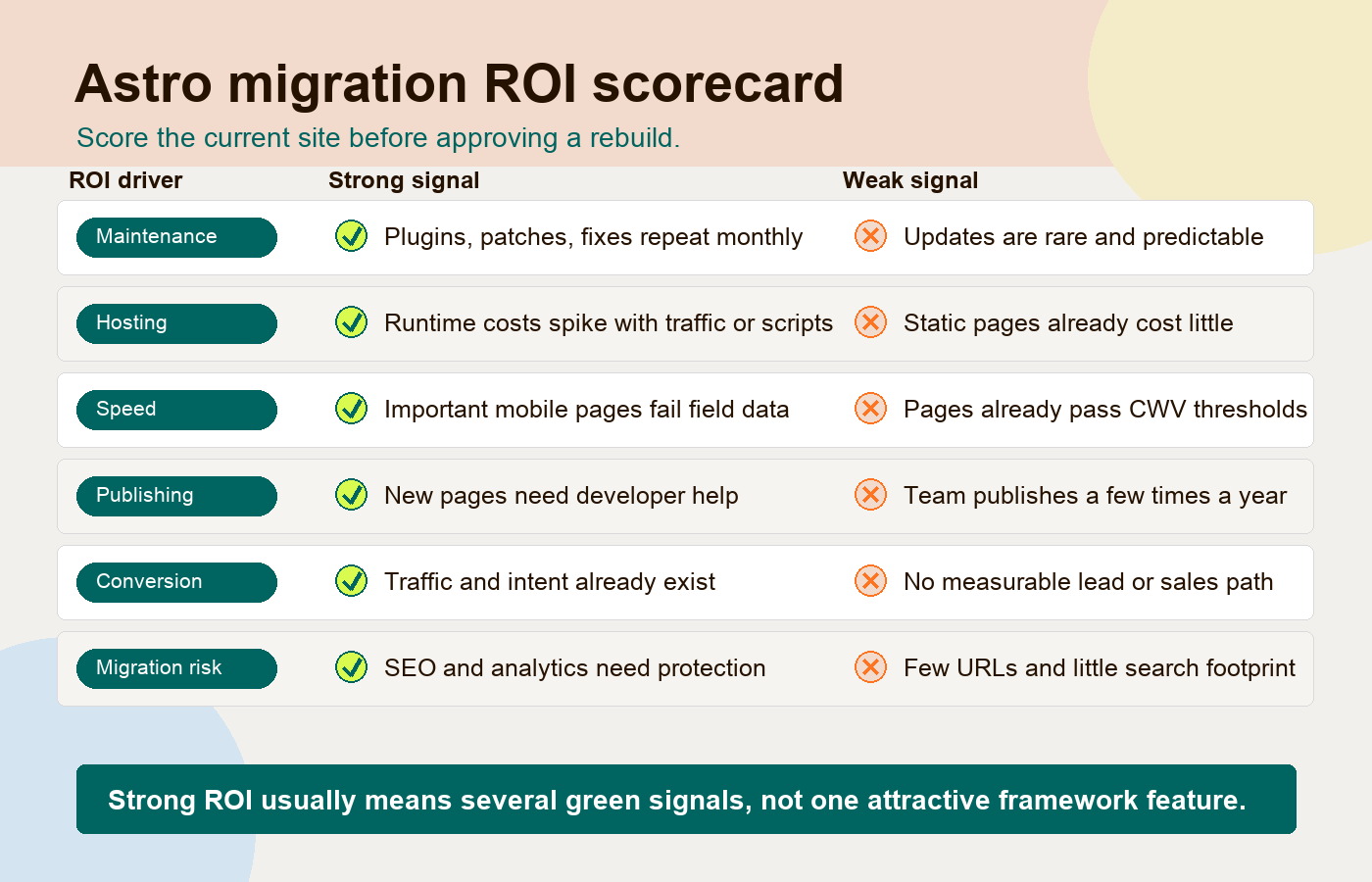
When the ROI is strong
The business case is strongest when several of these are true at the same time:
| Signal | What it suggests |
|---|---|
| The site has meaningful organic, paid, or referral traffic | Conversion and migration-risk work matter because the site already creates business value |
| WordPress, Webflow, Framer, or a custom CMS is limiting content work | The team can recover time by moving to reusable components and cleaner content models |
| Plugin or builder issues create recurring maintenance | Astro can reduce the public runtime and simplify ownership |
| Mobile performance is poor on important pages | Better Core Web Vitals may support retention and conversion |
| Hosting or serverless costs spike during campaigns | Static delivery and CDN caching can make the bill easier to forecast |
| The site needs landing pages, journals, docs, or resource hubs often | Publishing velocity becomes a real commercial advantage |
| SEO footprint is worth preserving | A structured migration audit protects URLs, metadata, schema, redirects, and analytics |
In other words, Astro ROI is rarely about liking Astro. It is about replacing a site operation that has become too slow, expensive, fragile, or difficult to scale.
When the ROI is weak
Astro is not always worth the migration cost. A small and simple site may not need it.
The ROI is usually weak when:
- The current site is already fast enough in field data.
- Hosting and maintenance costs are low.
- The team publishes only a few updates per year.
- There is no meaningful organic traffic, paid traffic, or conversion path.
- The site is mostly a logged-in web application with complex client-side state.
- The real problem is messaging, positioning, offer clarity, or sales process rather than the website stack.
- A focused cleanup of images, scripts, caching, forms, or templates would solve the current pain.
In those cases, the pragmatic move may be to optimize the existing site, rebuild only high-value landing pages, or wait until the business has enough traffic and publishing need to justify the platform change.
How to evaluate the migration before approving it
Do the evaluation in this order:
- Baseline the current site. Capture hosting, plugin, CMS, agency, developer, and maintenance costs. Pull Core Web Vitals field data where available, not only lab scores.
- Inventory what must be preserved. List URLs, redirects, metadata, schema, forms, analytics, pixels, CRM routing, content types, authors, categories, and high-value landing pages.
- Separate migration from redesign. A design refresh may be worth doing, but it changes the cost and timeline. Do not hide it inside the technical migration estimate.
- Model hard savings first. Count only the costs the business can actually remove or reduce.
- Model conversion upside second. Apply lift only to pages with traffic and measurable intent. Keep the assumption modest until tested.
- Add launch-risk work. Redirects, QA, analytics parity, form testing, sitemap review, and post-launch monitoring are not extras. They protect the return.
This is why a migration risk audit should come before the build. It turns “should we switch to Astro?” into a clearer business question: “Which parts of the current website are costing us money, slowing growth, or creating launch risk?”
The bottom line
Astro migration ROI is strongest for business websites where the current stack is creating recurring costs: maintenance, hosting complexity, slow content workflows, poor mobile performance, plugin risk, and weak publishing velocity. The return is weakest for small, simple sites that are already fast, cheap, and easy to maintain.
Treat Astro as a cleaner operating model for content-led websites, not a guaranteed SEO lever. The payoff comes when the migration protects what already works, removes recurring friction, and gives the team a faster system for publishing and improving revenue pages.
If the site already creates leads, traffic, or sales support, start with a migration risk audit before estimating the rebuild. The ROI case gets much clearer once the real costs, risks, and conversion opportunities are visible.