Astro for ecommerce websites makes sense when the storefront problem is mostly speed, content, campaign flexibility, product education, or SEO. It is much less compelling when the real problem is checkout, inventory, payments, shipping, refunds, subscriptions, or merchandising operations. In those cases, Shopify should usually stay the ecommerce system of record.
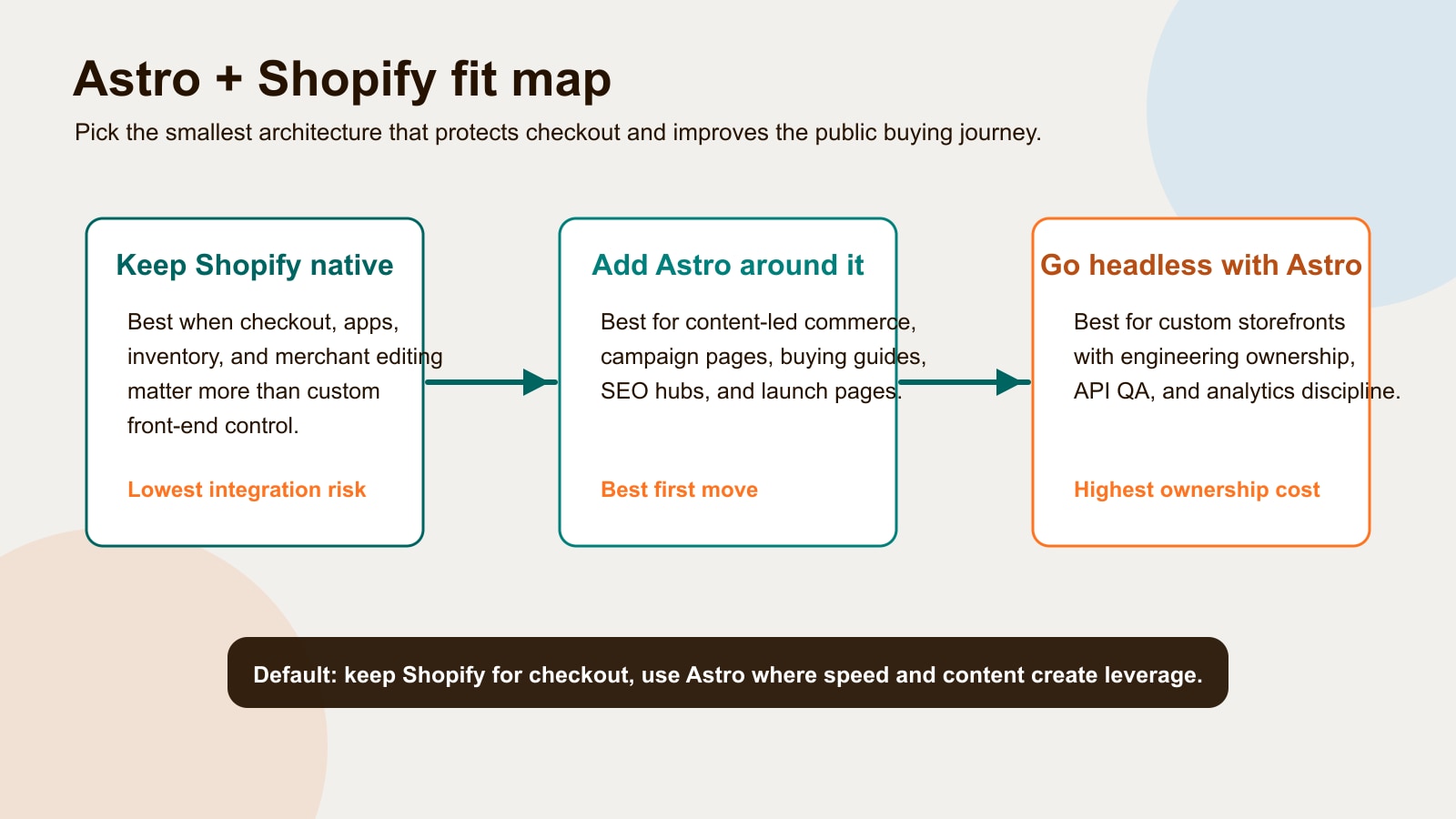
The practical answer is not “Astro vs Shopify.” For many stores, the better answer is Shopify plus Astro. Keep Shopify for the commercial engine. Use Astro where the website needs faster static pages, cleaner content models, fewer third-party scripts, and more control over landing pages or buying guides.
That distinction matters because ecommerce websites are not only pages. They are catalogs, carts, checkout sessions, inventory promises, payment flows, tax rules, shipping rates, analytics events, email triggers, customer accounts, and operational dashboards. Astro can make the front end cleaner. It does not remove the need to protect the commerce system behind it.
Before rebuilding, use an Astro migration ROI model to test whether maintenance savings, publishing speed, performance, and conversion potential justify the added integration and ownership cost.

The short answer: use Astro around commerce first
An Astro ecommerce site works best when Astro owns the experience layer and Shopify keeps the transactional layer. That can mean product storytelling pages, campaign landing pages, comparison hubs, buying guides, resource centers, programmatic SEO pages, or a custom storefront that still sends buyers to Shopify checkout.
Use this quick filter before planning a Shopify to Astro move:
| Store situation | Better fit | Why |
|---|---|---|
| The store is early, simple, and mostly needs reliable checkout | Shopify theme | Lower operating risk and less custom maintenance |
| The Shopify theme is slow because of apps, scripts, and campaign pages | Optimize Shopify first, then consider Astro sections | The bottleneck may be theme hygiene, not platform choice |
| Content, SEO, and landing pages drive acquisition | Astro around Shopify | Astro can own fast public pages while Shopify keeps commerce operations |
| The brand needs a highly custom buying experience | Headless Shopify with Astro or another front end | Useful only if the team can own APIs, QA, analytics, and checkout handoff |
| Checkout, subscriptions, loyalty, reviews, and apps are central | Keep Shopify native unless there is a strong reason | Rebuilding app behavior headlessly can become the hidden cost |
If the store is already selling well on Shopify, the first question should be: which parts of the buying journey need a better front end? The answer may be “product education and campaigns,” not “the entire store.”
Where Astro helps ecommerce websites
Astro is strongest where ecommerce meets publishing. Its islands architecture renders most of a page as static HTML and loads JavaScript only for interactive components that need it. For an ecommerce marketer, that matters on product explainers, category guides, paid landing pages, editorial commerce, launch pages, and comparison content.
On those pages, not every element needs a full application runtime. A sizing quiz, image carousel, cart drawer, product recommender, or email capture can be interactive. The rest of the page can stay lightweight HTML. That is the main architectural reason Astro is attractive for commerce pages that need to sell through education rather than app-like interaction.
Astro also works well for structured content. Its content collections can load Markdown, MDX, JSON, TOML, and remote content with schemas, which is useful when a team wants repeatable product guides, buying guides, comparison pages, author pages, launch pages, or glossary-style SEO content. A marketing team can get cleaner page patterns without pushing every content decision through a Shopify theme.
Performance is the commercial argument, but it should not be exaggerated. Google’s current Core Web Vitals focus on loading, interactivity, and visual stability: LCP within 2.5 seconds, INP at 200 milliseconds or less, and CLS at 0.1 or less at the 75th percentile. The web.dev summary of Deloitte’s retail research found that a 0.1 second mobile speed improvement increased progression from product details to add-to-basket by 9.1 percent, with retail consumers spending 9.2 percent more in the measured journeys.
That does not mean an Astro rebuild automatically improves revenue. It means speed is worth treating as commercial infrastructure. If the slowest parts of the store are content-heavy acquisition pages, Astro may be a good way to fix them. If the slowest part is checkout, payment approval, tax calculation, or third-party app behavior, Astro is not the root fix.
The Shopify checkout reality
Shopify is still the better operating system for many ecommerce teams because checkout is not just a button. It is payment security, shipping logic, tax handling, fraud controls, discounts, customer data, order creation, and post-purchase operations.
In a headless setup, Shopify’s Storefront API provides the commerce primitives: products, collections, cart operations, contextual pricing, and customer-facing commerce data. A custom Astro front end can query those primitives and render a faster or more controlled experience.
The current API setup adds a few decisions that should be in the architecture brief. Shopify releases Storefront API versions four times a year, so pin the storefront to a supported stable version and schedule upgrades. The Headless channel can issue public and private tokens and reports order attribution at the channel level. Keep private tokens on the server and request only the scopes the storefront needs. Tokenless access has a query-complexity limit of 1,000 and does not expose every token-protected capability, so use token-based access when the storefront needs those fields or higher-complexity queries.
But the handoff to checkout still needs discipline. Shopify’s Cart object includes a checkoutUrl that directs the buyer to Shopify’s web checkout. That is a strength because the final purchase can stay inside Shopify’s hardened checkout system. It is also a constraint because the custom storefront must preserve cart state, buyer identity, discounts, consent, analytics attribution, and expectations across that handoff.
There are API realities too. Shopify’s rate-limit guidance says real-buyer Storefront API requests are not subject to a fixed request-per-minute limit, while automated traffic is rate-limited and checkout creation has a separate throttle. Build a queue with backoff and test the failure path during campaigns, crawls, flash sales, bot traffic, and any ecommerce Astro migration that creates or mutates carts through custom code. For server-side buyer requests, pass the buyer IP as Shopify documents so its bot and platform protection can distinguish buyer traffic from a crawler.
The point is simple: headless does not mean “free from Shopify.” It means your team now owns the front-end architecture and the integration surface between Astro and Shopify. The more the store depends on custom pricing, bundles, subscriptions, loyalty, reviews, recommendations, inventory freshness, markets, or B2B logic, the more expensive that ownership becomes.
Three patterns that usually work
1. Shopify native store plus Astro content
This is the safest pattern for many stores. Shopify keeps the storefront, product pages, checkout, apps, inventory, and order operations. Astro powers a content hub, buying guides, campaign pages, comparison pages, or resource center on the same domain or a carefully managed subdirectory.
This works when content-led commerce is the growth channel. A brand selling skincare, home goods, equipment, fashion, software-enabled hardware, or niche B2B products may need more than a product grid. It may need education, comparison, care guides, use-case pages, and search-friendly buying advice. Astro can make those pages fast and structured without disturbing the store’s transaction flow.
This is also the cleanest place to start if the team is considering a larger Shopify to Astro move. It creates a measurable first slice: publish a set of high-value pages, connect analytics and CTAs, link into Shopify product or collection pages, and compare performance before touching checkout.
2. Astro campaign and landing pages around Shopify
This pattern is useful when paid campaigns, product launches, seasonal drops, or partner campaigns outgrow Shopify’s page editing workflow. Astro can give the team reusable landing page sections, faster builds, cleaner metadata, custom forms, and controlled analytics events.
The pages do not have to own checkout. They can push visitors into Shopify collections, specific product pages, add-to-cart flows, or checkout paths. The migration risk is lower because Astro is improving acquisition pages rather than replacing the commercial system.
If you are already comparing platform choices, Hapy’s Webflow vs Shopify article is a useful adjacent read: Shopify is usually stronger for store operations, while visual builders are often stronger for content and design control. Astro enters that same conversation as a custom, developer-owned option for teams that need more performance and ownership than a visual builder can provide.
3. Full headless Astro storefront
A full Astro ecommerce site is the highest-control option. Astro renders the product listing pages, product detail pages, navigation, cart UI, search experience, and content. Shopify, Medusa, WooCommerce, BigCommerce, or another backend provides product data and transaction logic.
This can be right when the brand has unusual front-end needs: complex editorial commerce, advanced product configurators, a high-volume SEO strategy, multi-brand content architecture, custom merchandising logic, or a front end that must share components with other digital products.
It is also the pattern with the most ownership. The team must maintain product data fetching, cart mutations, stale data rules, inventory display, checkout handoff, redirects, analytics, accessibility, observability, security headers, customer account behavior, and regression testing. A full ecommerce Astro migration should be treated like a software product, not a theme swap.
Migration risks to map before moving
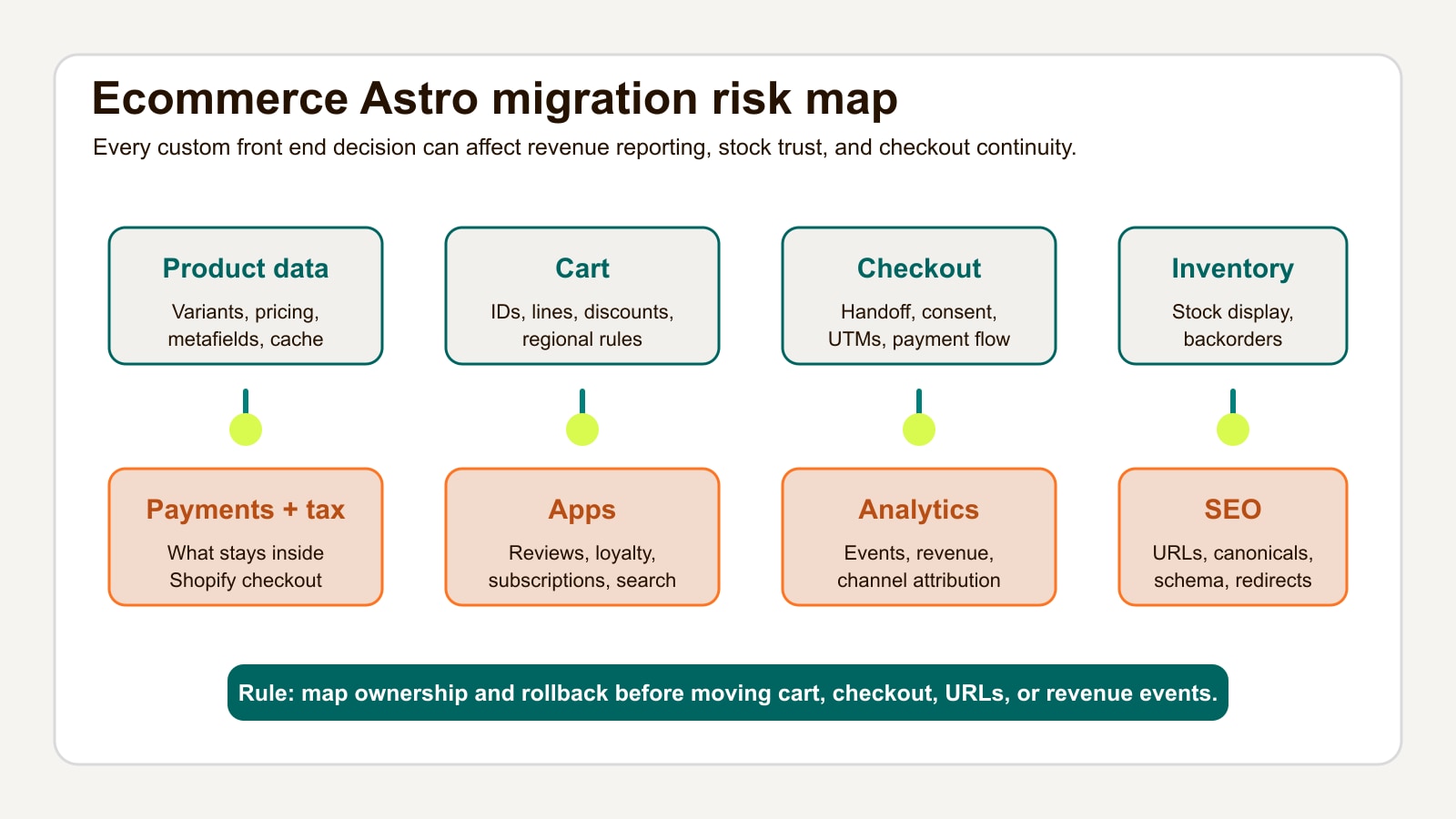
The biggest risk in a Shopify to Astro project is assuming the front end is separate from operations. It is not. A product card can affect inventory trust. A cart drawer can affect discount rules. A checkout redirect can affect analytics attribution. A route change can affect organic traffic.
Before moving a store or section, map the risks:
| Area | What can break | What to decide before build |
|---|---|---|
| Product data | Missing variants, stale pricing, broken metafields, inconsistent product status | Source of truth, sync cadence, cache rules, fallback states |
| Cart | Lost cart IDs, duplicate lines, discount mismatch, regional pricing errors | Cart storage, mutation flow, error handling, recovery path |
| Checkout | Buyer drops context when moving to Shopify checkout | Checkout URL handoff, consent, discount codes, UTM persistence, analytics |
| Inventory | Pages promise items that are unavailable or delayed | Stock display rules, reserve logic, backorder messaging, refresh timing |
| Payments and tax | Custom front end implies control the team does not actually have | What remains in Shopify checkout, what is surfaced before checkout |
| Apps | Reviews, subscriptions, loyalty, upsells, bundles, and search do not appear automatically | App-by-app headless support, custom replacements, ownership |
| Analytics | Revenue, add-to-cart, checkout, and campaign reporting split across systems | Shared event schema, channel attribution, test plan, post-launch audit |
| SEO | URLs, canonicals, schema, sitemaps, and internal links change | URL inventory, redirect map, sitemap ownership, Search Console checks |
Google’s site move guidance is relevant even when the domain stays the same. It recommends mapping URLs, using permanent redirects when pages move, monitoring Search Console, and even moving a site in smaller pieces when that reduces risk. That is exactly how an ecommerce Astro migration should be approached: move the part with the clearest upside first, measure it, then decide whether the next slice is worth the added complexity.
For a broader version of that process, see Hapy’s website platform migration page and the partial Astro migration guide. Ecommerce just raises the stakes because every public-page decision can touch revenue reporting and store operations.
When Shopify should stay
Many stores should keep Shopify native. That is not a conservative answer; it is often the commercially correct one.
Keep Shopify as the primary storefront when:
- The store is small or mid-sized and does not have dedicated engineering support.
- Checkout reliability matters more than custom front-end control.
- Shopify apps are central to reviews, subscriptions, loyalty, upsells, search, or merchandising.
- The marketing team needs self-service editing more than a custom component system.
- The performance issue can be fixed by theme cleanup, image optimization, app reduction, and tracking discipline.
- The store does not have enough revenue or traffic for a custom front end to pay back its ongoing maintenance.
- Analytics, fulfillment, and customer support already work well inside Shopify.
An optimized Shopify theme is not a failure. It is a good operating choice when the business needs fewer moving parts. If the team mainly wants a cleaner blog, faster landing pages, or better product education, use Astro around the store before rebuilding the store.
When Astro is worth serious consideration
Astro deserves a serious look when the store’s growth depends on public content and the current platform makes that content slow, rigid, or hard to scale.
Strong signals include:
- Organic acquisition depends on guides, comparisons, glossaries, editorial commerce, or programmatic landing pages.
- Paid campaigns need many fast landing pages with tight analytics and reusable sections.
- The current Shopify theme is overloaded with app scripts that do not belong on every page.
- Product education matters as much as product catalog browsing.
- The business has in-house developers or a long-term technical partner.
- The team wants a content model that is easier to version, validate, and reuse.
- The migration can start with a low-risk section before checkout or core product pages move.
This is where Astro can become a competitive advantage. Not because it is fashionable, but because it lets a team separate content and performance work from the heavier commerce engine. The brand gets a faster public experience. The operations team keeps the platform that already manages orders.
A practical decision checklist
Use this before approving an ecommerce Astro migration:
| Question | If yes | If no |
|---|---|---|
| Is the problem mostly content, speed, SEO, or campaigns? | Astro may help | Fix Shopify/theme operations first |
| Does Shopify checkout already work well? | Keep checkout in Shopify | Audit checkout before touching front end |
| Are apps central to the buying journey? | Expect custom headless work | Migration scope is simpler |
| Can the team maintain APIs and custom components? | Headless is realistic | Use Astro for contained sections only |
| Are URLs and rankings valuable? | Treat it as a migration project | Lower SEO risk, but still QA metadata |
| Can analytics be tested across both systems? | Proceed with measurement discipline | Do not launch until attribution is mapped |
| Is there a rollback plan? | Safer to test a first slice | Scope is not ready |
The best ecommerce Astro projects begin with a boring document: what stays in Shopify, what moves to Astro, what data crosses the boundary, and who owns each failure mode.
The bottom line
Astro for ecommerce websites is most useful when the store needs a faster, cleaner, more controllable public experience around the commerce engine. It is a strong fit for content-led commerce, landing pages, buying guides, product education, and carefully scoped headless storefronts.
Shopify should stay when the store mainly needs reliable checkout, inventory, payments, shipping, apps, reporting, and merchant autonomy. Replacing that with Astro is not a migration; it is a custom commerce product.
For most teams, the smart move is not a full Shopify to Astro rebuild. It is a staged architecture: keep Shopify where money changes hands, use Astro where speed and content control create leverage, and only move deeper into headless commerce when the business case is stronger than the integration risk.