SaaS product development is the work of turning a recurring software business into a product people can adopt, pay for, keep using, and expand. That means the job is bigger than “build a multi-tenant app.” A serious SaaS product also needs onboarding, billing, roles, admin tools, analytics, support workflows, security controls, and a roadmap that connects product decisions to SaaS economics.
That is the founder-level mistake this guide is meant to fix. Many early teams scope SaaS as screens and features. The better question is: what is the smallest reliable system that can prove the next business milestone?
For a pre-seed founder, that milestone might be paid pilot evidence. For a seed-stage team, it might be activation, retention, and expansion inside a narrow ICP. For a vertical SaaS company, it might be workflow depth in one industry. For an AI-enabled SaaS product, it might be trust, cost control, and repeatable output quality. The product plan should change with the milestone.
If you are still deciding whether to build at all, start with Hapy’s MVP development process and the guide to SaaS product-market fit. If you already know the category, use this guide to plan what the first production version should include, what to postpone, what drives SaaS product development cost, and when a SaaS development company is the right build model.
If version one depends on model outputs, pair this roadmap with the AI MVP development guide so evaluation, data readiness, privacy, human review, and model cost are scoped before the feature reaches customers.
Start With the SaaS Milestone, Not the Feature List
The right SaaS MVP scope depends on the evidence the founder needs next. A demo, pilot, paid beta, self-serve launch, and enterprise proof point are different products, even when they share the same long-term vision.
The Lean Startup principle is still useful here: build the smallest version that can create validated learning. But SaaS makes the question sharper because the product has to produce business evidence after signup, not only curiosity before signup. A landing page can prove interest. A SaaS MVP has to prove that users can activate, return, invite others, pay, or rely on the workflow.
Use this sequence before writing the roadmap:
- Define the customer segment tightly.
- Name the recurring workflow the product owns.
- Identify the core action that proves value.
- Decide what evidence is needed for the next milestone.
- Scope the smallest reliable release that can capture that evidence.
- Set an exclusion list for everything that does not support the milestone.
For example, a vertical SaaS product for dental clinics does not need every scheduling, billing, insurance, and reporting feature in version one. It may need one high-friction workflow, clinic roles, audit history, imported sample data, and a support-friendly admin view. A B2B workflow SaaS for procurement may need approvals, role-based access, notification trails, and CSV import before it needs a public API. A marketplace SaaS may need trust, supply-side operations, payments, and dispute handling before it needs advanced discovery.
What a SaaS MVP Should Include
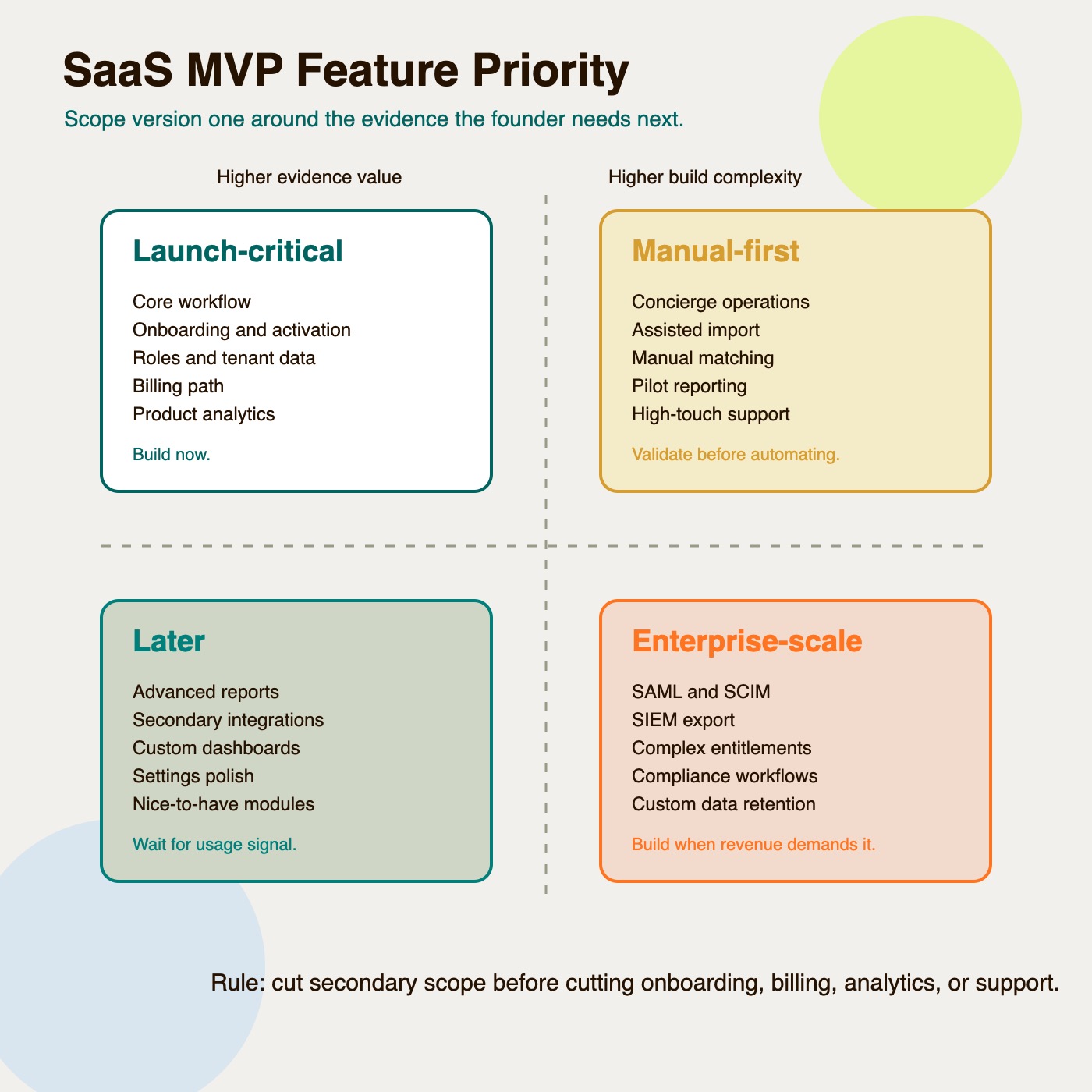
A SaaS MVP should be narrow in product scope but complete enough to support real usage. That means the founder should cut secondary modules before cutting the systems that make SaaS measurable, billable, secure, and supportable.
| Area | MVP priority | Why it matters | Example |
|---|---|---|---|
| Core workflow | Must-have | Proves the product solves a recurring job | Create, approve, and track a vendor request |
| Onboarding | Must-have | Determines whether users reach the value moment | Guided setup with sample data and one clear first action |
| Authentication and roles | Must-have | Protects accounts and separates admin, user, and support actions | Owner, manager, member, and support roles |
| Tenant-aware data model | Must-have | Prevents painful rewrites when more customers join | Every customer-owned record carries a tenant or organization id |
| Billing or payment validation | Must-have for commercial tests | Shows whether the product can become a SaaS business | Stripe checkout, invoice workflow, paid pilot contract, or usage ledger |
| Product analytics | Must-have | Measures activation, retention, and feature usage | Signup, activation, invite, core action, and billing events |
| Admin and support tooling | Must-have, but minimal | Lets the team fix customer issues without database surgery | Account lookup, plan override, impersonation audit, failed job retry |
| Integrations | Selective | Only build integrations that unblock the core workflow | Google Workspace SSO, accounting export, Slack alerts |
| Advanced reporting | Usually later | Often expensive and easy to overbuild before users know what they need | Custom dashboard builder |
| Enterprise controls | Later unless selling upmarket now | Needed for procurement, but can distract early teams | SAML, SCIM, SIEM export, custom retention policies |
The practical rule: version one should feel small to the market, not fragile to the user. A narrow SaaS app can be trustworthy. An underbuilt one trains customers not to rely on it.
Architecture Is a Business Decision
SaaS architecture affects margin, security, onboarding, support, and future sales motion. Founders do not need to make every infrastructure decision personally, but they should understand the tradeoff behind the major ones.
The first big choice is tenancy. AWS describes three common relational database patterns for SaaS storage: silo, bridge, and pool. In the silo model, each tenant has separate database infrastructure. In the bridge model, tenants are separated inside shared infrastructure, often by schema or database. In the pool model, tenants share common tables and records are separated by a tenant identifier.
| Pattern | Best fit | Tradeoff |
|---|---|---|
| Pooled shared database | Early and mid-market SaaS with many similar tenants | Lower cost and simpler updates, but requires disciplined row-level isolation |
| Schema or database per tenant | B2B SaaS with some tenant variation or migration needs | More isolation and flexibility, but more migration and monitoring overhead |
| Database per tenant | Enterprise, regulated, or high-volume tenants | Strongest separation, but highest operational cost and automation burden |
For many SaaS MVPs, a pooled model with strong isolation is the right starting point. AWS Prescriptive Guidance says row-level security is required to maintain tenant isolation in a pooled PostgreSQL model and recommends setting tenant-specific context at runtime rather than creating a database user for every tenant. PostgreSQL’s own row security policy documentation explains how policies can restrict which rows are visible or writable based on the active user or session context.
That does not mean “add tenant_id later.” It means design the data model around organizations, memberships, roles, and tenant-owned records from the start. Retrofitting tenancy after customers are live is one of the most expensive ways to discover that SaaS architecture is not just an engineering detail.
AI-enabled SaaS adds another architecture layer. If the product uses retrieval-augmented generation, agents, or usage-based AI actions, the MVP needs data ingestion, permissions-aware retrieval, prompt and output logging, evaluation, spending limits, and abuse controls. A chatbot bolted onto a shared knowledge base is not the same thing as tenant-safe AI workflow software.
Onboarding Is Part of the Product, Not a Tour
Onboarding is where SaaS development becomes economics. A user who signs up but never reaches the value moment does not create retention, expansion, or pricing evidence.
Good onboarding should answer three questions quickly:
- Where am I?
- What should I do first?
- How will I know the product worked?
For a vertical SaaS product, onboarding may require templates that match the customer’s industry. A clinic, logistics company, legal team, or construction contractor should not start from a blank dashboard. For B2B workflow SaaS, onboarding often needs role-based paths: admins configure teams, while everyday users move straight into the task they were invited to complete. For marketplace SaaS, onboarding has to manage both sides of the market, often with more manual operations behind the scenes than the interface reveals.
The first release should usually include:
- A short setup path tied to one outcome.
- Sample data or templates that make the empty state understandable.
- A visible checklist with three to seven meaningful actions.
- Deferred profile fields unless they are needed for activation.
- Lifecycle emails or in-app prompts tied to unfinished setup.
- Analytics events for signup completion, activation, invite, and return usage.
Do not treat onboarding as decoration after the build. If activation is weak, the product can look like it has a market problem when the real issue is a path-to-value problem.
Billing and Entitlements Should Be Decoupled Early
Billing takes money. Entitlements decide what the customer can do. Founders often combine those two systems too tightly in the first SaaS app, then struggle when pricing changes.
Stripe’s documentation on subscription prorations shows why billing becomes operational quickly: plan changes, quantity changes, discounts, trials, and billing-cycle changes can all affect invoice behavior. Stripe’s Smart Retries also shows that failed-payment recovery is its own lifecycle, not just a failed charge event.
The product should not call an external billing API on every request to decide whether a user can take an action. Instead, the SaaS app should keep a local entitlement state that answers questions like:
- Is this customer active, trialing, paused, delinquent, or canceled?
- Which plan features are available?
- How many seats, projects, locations, or credits remain?
- Is this account inside a grace period?
- Should the product hard-block, soft-limit, or downgrade access?
This matters even more with usage-based and AI-enabled SaaS. Stripe’s guide to usage-based pricing frames the model around charging as usage scales, but the application still has to meter usage accurately, prevent double-spending, set customer limits, and keep margins visible. If an AI feature costs real money every time it runs, the MVP needs usage controls before volume arrives.
Analytics, Admin, and Support Are Not Optional
Analytics tells the founder whether the SaaS product is working. Admin and support tooling keeps early customers from depending on engineers for every fix. Both are easy to postpone because they are less visible than customer-facing features. Both become expensive when skipped.
At minimum, SaaS app development should instrument:
| Event category | Examples | Business question answered |
|---|---|---|
| Acquisition and signup | Signup started, signup completed, source, invite accepted | Are the right users entering the product? |
| Activation | Workspace created, first import, first task completed, first report sent | Are users reaching the value moment? |
| Retention | Return sessions, recurring workflow completion, collaboration events | Are customers forming a habit? |
| Expansion | Seat invited, limit reached, integration connected, feature gated | Where should packaging and upsell live? |
| Support risk | Failed jobs, permission errors, billing failures, webhook failures | What will create churn or support load? |
The admin side should be just as intentional. Early SaaS teams need customer lookup, account status, billing state, plan override, feature flags, safe impersonation, audit trails, and failed-job retry. Secure impersonation is especially sensitive: require a support reason, show a visible banner during the session, scope the token, and write immutable audit events.
This is also where founders should connect product analytics to SaaS product-market fit. Rahul Vohra’s First Round Review essay on Superhuman’s PMF engine popularized the “very disappointed” survey benchmark and showed how segmentation moved Superhuman from 22% toward a stronger product-market fit score. The key lesson for founders is not the number alone. It is the discipline of linking product decisions to the segment that would most miss the product.
Security and Enterprise Readiness Should Match the Buyer
Security should not wait until a large prospect asks for a questionnaire. But the depth of security work should match the target buyer and data risk.
A self-serve SMB SaaS MVP may need secure authentication, tenant isolation, role-based access, audit logging for sensitive actions, encrypted secrets, backup and restore, vulnerability patching, and privacy basics. A product selling to enterprise customers may also need SAML or OIDC single sign-on, SCIM provisioning, fine-grained RBAC, data retention controls, SIEM-friendly logs, vendor security documentation, and a path toward SOC 2.
Federated identity is a good example of scope depending on buyer. Clerk’s 2026 guide to SAML, OIDC, and SCIM for enterprise SaaS explains the practical distinction: SAML and OIDC handle login federation, while SCIM handles account lifecycle and deprovisioning. If enterprise customers are the first milestone, those controls may be core MVP scope. If not, they can sit in the “Next” roadmap until sales evidence supports the investment.
A Practical SaaS Product Roadmap
A SaaS product roadmap should separate validation, reliability, monetization, and scale. A Now-Next-Later format is often healthier than pretending the team can predict exact delivery dates six months out.
| Horizon | Founder question | Product focus | Engineering focus | Evidence to collect |
|---|---|---|---|---|
| Now | Can one segment complete the core job? | Core workflow, onboarding, roles, analytics | Tenant-aware data model, auth, billing/payment path, QA | Activation, first value, paid pilot, weekly usage |
| Next | Can users repeat and pay? | Admin tooling, support paths, pricing packages, key integrations | Entitlements, observability, audit logs, data exports | Retention, conversion, support load, expansion triggers |
| Later | Can the product scale into a repeatable SaaS business? | Enterprise controls, advanced reporting, partner APIs, AI optimization | SAML/SCIM, usage ledger, performance, data warehouse, compliance readiness | NRR direction, CAC payback, sales cycle, procurement pass rate |
The roadmap should also name what is deliberately excluded. An exclusion list is not pessimism. It protects the team from building features that do not move the milestone.
Examples:
- A vertical SaaS MVP may exclude custom report builders, but include industry templates and role-specific workflows.
- A B2B workflow SaaS MVP may exclude every ERP integration, but include CSV import/export and one integration needed for the first ICP.
- An AI-enabled SaaS MVP may exclude fine-tuning, but include retrieval permissions, evaluation logging, and token spend limits.
- A marketplace SaaS MVP may exclude algorithmic matching, but include manual review, payments, messaging, trust controls, and admin operations.
SaaS Product Development Cost Drivers
SaaS product development cost is driven less by the word “SaaS” and more by the operational system behind the product. A basic dashboard with login and subscription billing is not the same as a multi-tenant workflow platform with AI usage metering, role-based permissions, audit logs, enterprise SSO, and marketplace payments.
| Cost driver | What increases cost | Founder decision |
|---|---|---|
| Workflow depth | More steps, edge cases, states, and exceptions | Keep version one centered on one recurring job |
| User roles and permissions | Admins, managers, members, guests, support, vendors | Model roles early, but keep permissions simple |
| Tenancy and data isolation | Shared, schema-per-tenant, or database-per-tenant design | Match architecture to buyer risk and scale assumptions |
| Billing complexity | Trials, tiers, seats, usage, credits, discounts, dunning | Decouple entitlements from invoices |
| Integrations | CRMs, ERPs, identity providers, payments, analytics | Build only integrations that unblock adoption or payment |
| AI features | Data ingestion, retrieval, evaluation, token cost controls | Budget for quality and usage governance, not just model calls |
| Compliance | SOC 2, HIPAA, GDPR, audit trails, access reviews | Treat compliance as product scope when buyers require it |
| Team model | Freelancers, in-house, hybrid, agency, SaaS development company | Choose based on risk ownership, not hourly rate alone |
| Post-launch iteration | Fixes, onboarding changes, pricing tests, support tools | Preserve budget after launch so learning can happen |
Use a scoped estimate rather than a universal SaaS price range. As a hypothetical September 2026 planning example, 400 hours at an assumed blended $125 per hour gives $50,000 for explicitly included discovery, design, build, and QA work. Add separately quoted hosting, third-party fees, migration, specialist review, support, and contingency. Those hours and rates are illustrative, not a market benchmark or Hapy offer; integrations and buyer requirements can change them substantially. Hapy’s separate guide to MVP development cost breaks down broader startup budget ranges.
The important budgeting move is to reserve money for after launch. A SaaS MVP without post-launch iteration is usually underfunded, even if the initial build is technically complete. Users will reveal unclear onboarding, weak packaging, missing support workflows, and analytics gaps. That learning is the point of version one.
Team Model: In-House, Outsourced, or SaaS Development Services
The right team model depends on what risk the founder needs owned.
| Team model | Best fit | Watchout |
|---|---|---|
| In-house team | Core platform after product risk drops | Hiring is slow and fixed burn starts early |
| Freelancers | Small, well-scoped builds with a technical founder | Founder becomes product manager, QA lead, and architect |
| Fully outsourced team | Defined execution with clear specs | Knowledge transfer and quality control can become hidden costs |
| Hybrid team | Founder or internal lead owns product, partner adds execution | Requires strong product discipline and decision rhythm |
| SaaS development company | Strategy, UX, architecture, build, QA, and launch need one operating system | Choose for judgment and ownership, not only portfolio polish |
AI coding tools change this calculation, but they do not remove product judgment. Measure AI assistance on your own representative tasks, including review, corrections, and defects; task-level speed does not establish end-to-end SaaS delivery savings. It does not decide what to build, how to validate demand, how to model tenancy, how to price usage, or where the product should say no.
For early founders, the best SaaS development services combine product strategy, design, engineering, QA, and technical leadership close to the same roadmap. Separating those responsibilities across too many vendors can create the illusion of savings while forcing the founder to become the system integrator.
Build-Readiness Checklist
Before paying for SaaS app development, founders should be able to answer the questions below. If too many answers are unclear, spend on discovery, customer interviews, prototype testing, or a smaller validation experiment first.
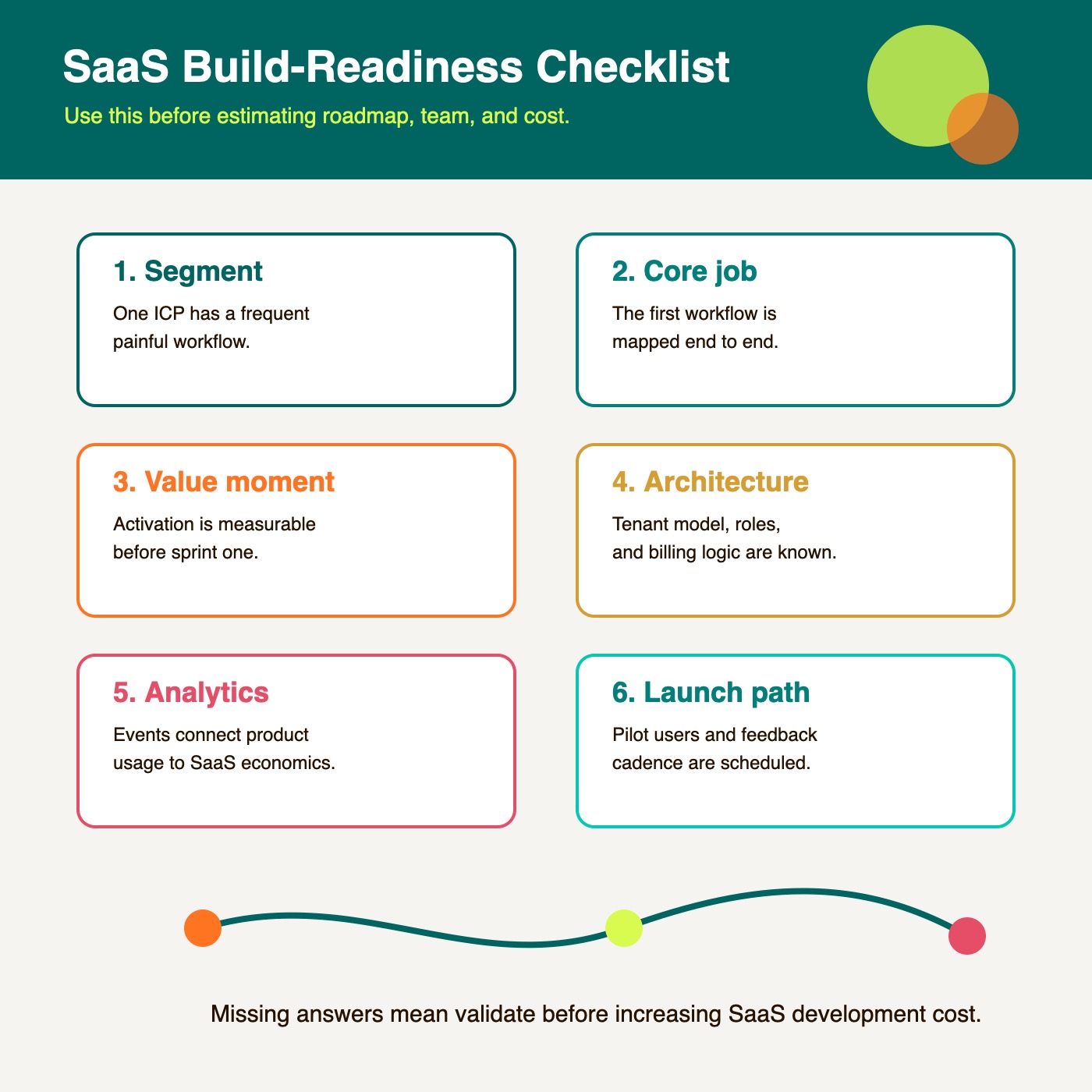
| Readiness area | Build-ready signal | If unclear, do this first |
|---|---|---|
| Customer segment | One ICP has a frequent, painful workflow | Start with a deliberately selected group of target users; expand across roles and conflicting evidence |
| Core job | The product owns one recurring workflow | Map the workflow and remove secondary paths |
| Value moment | The first meaningful action is measurable | Define activation before designing screens |
| Business model | Pricing thesis matches value or cost | Read the SaaS business model guide and test willingness to pay |
| Category strategy | Vertical, horizontal, AI, or marketplace tradeoffs are explicit | Compare vertical SaaS vs horizontal SaaS and choose the wedge |
| MVP scope | Must-have, manual-first, later, and excluded features are separated | Create an MVP priority table before estimating |
| Architecture | Tenant model, roles, data ownership, and billing approach are known | Run technical discovery before UI build |
| Analytics | Activation, retention, usage, and billing events are listed | Write the event plan before sprint one |
| Support | Admin actions and audit requirements are defined | Design support tooling with the product, not after launch |
| Launch plan | Pilot users, onboarding path, and feedback rhythm are scheduled | Secure design partners before the full build |
Interview counts are planning heuristics, not statistical proof of demand. Record who was eligible, who declined, which segment each participant represents, and what behavior supports the conclusion.
For an illustrative delivery decision, a procurement SaaS pilot might launch one request-and-approval workflow with CSV import, organization roles, payment validation, and support logs. It would defer a report builder until repeated customer requests justify it. Acceptance would include forbidden cross-tenant access tests, a successful paid pilot workflow, and a measured activation baseline. This is a hypothetical scope example, not a Hapy client outcome.
This checklist is intentionally business-heavy. The biggest SaaS product development failures rarely come from the team forgetting a button. They come from building a product that cannot prove adoption, cannot charge cleanly, cannot be supported safely, or cannot connect usage to revenue.
What to Build First in Different SaaS Categories
The first release should change based on the category.
Vertical SaaS
Build around industry workflow depth. A construction, healthcare, legal, logistics, or education SaaS product should feel native to the user’s operating context. Version one should prioritize templates, terminology, roles, approvals, compliance-sensitive audit history, and data import that reflects the vertical. Broad platform features can wait.
B2B Workflow SaaS
Build the handoff. Workflow SaaS often fails when it solves one user’s task but ignores the manager, approver, admin, or downstream team. Version one should include roles, notifications, status visibility, permissions, and analytics for the recurring workflow. Integrations matter only when they remove adoption friction.
AI-Enabled SaaS
Build trust and cost controls before novelty. The first release should include data boundaries, retrieval permissions, output evaluation, logs, human review where needed, and usage limits. If the product charges by outcome or usage, the ledger has to be reliable before customers scale.
Marketplace SaaS
Build liquidity and operations, not just profiles. A marketplace MVP needs buyer and seller flows, trust controls, messaging or requests, payments or payment validation, dispute paths, and internal admin tooling. Manual matching can be acceptable early if it creates evidence that the market wants the transaction.
When to Hire a SaaS Development Company
Hire a SaaS development company when the work is bigger than coding tickets and the cost of getting scope wrong is high. That usually means the founder needs help with product roadmap, UX, architecture, development, QA, analytics, and launch planning at the same time.
A good partner should be willing to reduce scope, not just estimate it. They should ask about the SaaS economics behind the feature list:
- What milestone does this release need to prove?
- Which segment will use it first?
- What activation event predicts retention?
- How will billing, entitlements, and support work?
- What can stay manual until there is evidence?
- Which architecture decisions are expensive to reverse?
- How much budget remains for launch and iteration?
That is the difference between buying software output and buying a better product decision. The right first release does not prove everything. It proves enough to make the next decision clearer.
The Bottom Line
SaaS product development should be scoped as a business system, not a generic app build. The founder is not only buying screens, databases, and subscriptions. They are buying a path to evidence: activation, retention, revenue, expansion, supportability, and a roadmap that can survive real users.
Start small, but do not start shallow. Build the core workflow, onboarding, tenant-aware architecture, billing or payment validation, analytics, admin support, and security baseline needed for the next milestone. Cut the rest until the product earns it.