The type of software development your project needs follows from the outcome, users, devices, data, and operating constraints. A customer portal may need frontend, backend, integration, cloud, and QA work together. These are complementary disciplines, not mutually exclusive product choices.
Start by describing the job users must complete and where they will do it. Then identify the skills and risks behind that workflow before choosing a team or technology.
Match the project to the work
| Project outcome | Required disciplines to assess | Staffing questions | Main risks to test |
|---|---|---|---|
| Marketing site or content publication | Web frontend, content modeling, accessibility, analytics, hosting | Who owns editing and content migration? | Broken URLs, inaccessible content, slow pages, failed forms |
| Customer or employee portal | UX, frontend, backend, identity, data, integrations, QA | Is there a technical owner across the full workflow? | Unauthorized access, incorrect states, integration failure, support gaps |
| Field-service mobile app | Mobile, backend, synchronization, device testing, release operations | Does the team understand the actual devices and connectivity? | Lost offline changes, conflicts, battery use, location permissions |
| Desktop productivity tool | Desktop platform engineering, file handling, packaging, updates | Who owns installation, signing, and support? | File corruption, update failure, OS compatibility |
| Operational reporting system | Data engineering, integration, analytics, interface design | Who validates source definitions and reconciliation? | Stale data, duplicated records, misleading metrics |
| Connected device | Embedded software, hardware integration, communications, safety testing | Are firmware and hardware owners working together? | Timing failures, unreliable updates, resource limits, unsafe behavior |
| Game or simulation | Game engineering, graphics, design, audio, performance, QA | Which engine and device experience is required? | Frame-rate limits, asset pipelines, multiplayer state, device coverage |
A single person may cover several areas on a small project. Ask for evidence of that coverage rather than equating a broad job title with all required skills.
Frontend, backend, and full-stack development
Frontend work implements the interface users interact with: layout, controls, states, accessibility, and behavior across relevant screens and browsers. It works alongside product and UX design; implementing a screen and deciding whether it solves the user’s problem are related but distinct tasks.
Backend work covers server-side business rules, data storage, authentication and authorization, jobs, and integrations. It must define what happens when inputs are invalid, a service is unavailable, or an action is repeated.
A full-stack developer works across frontend and backend. That can reduce handoffs in a small team, but does not automatically provide specialist expertise in security, mobile platforms, data science, or operations. For a portal, test a complete workflow rather than evaluating each layer only in isolation.
Web, mobile, and desktop are delivery surfaces
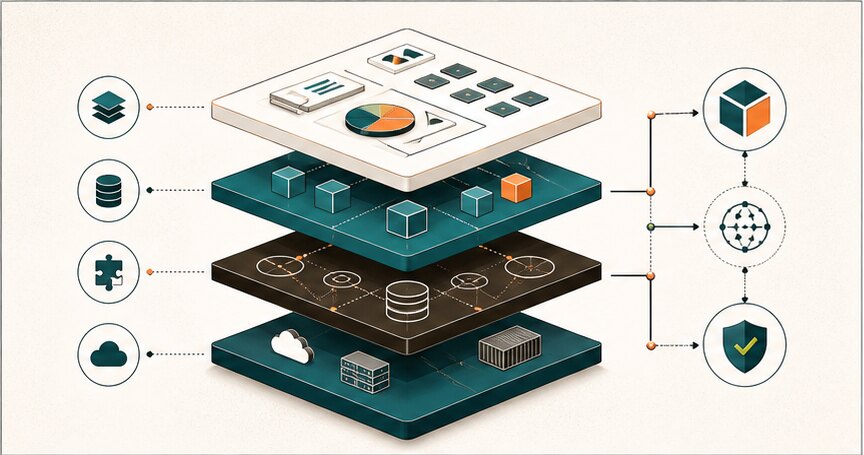
Web applications run through a browser. Mobile applications target phone or tablet platforms through native or cross-platform approaches. Desktop applications target systems such as Windows, macOS, or Linux. The same product may use more than one surface and share backend services.
Connectivity is a design choice, not a simple web-versus-mobile distinction. A mobile app can require a network for its core task; a web app can support selected offline behavior. Specify what must work offline, what data is stored locally, and how conflicts are resolved after reconnection.
Choose a surface around user context, device capabilities, distribution, update requirements, and support. Compare cross-platform app development when shared mobile implementation is relevant, and mobile outsourcing when choosing delivery support.
Cloud, APIs, and data engineering
Cloud engineering covers deployment infrastructure, configuration, scaling, monitoring, access, cost, and recovery. Hosting an application in the cloud does not remove operational responsibility. Define who can deploy, who responds to incidents, and how the system is restored.
API development creates a contract for systems to exchange data or actions. Specify authentication, permissions, input validation, versioning, rate limits, errors, and retry behavior. A successful demo request does not prove a production integration is reliable.
Data engineering handles ingestion, transformation, storage, lineage, and quality. Reporting and AI products depend on correct definitions and access controls as well as code. Assign someone to reconcile outputs with source records and investigate discrepancies.
Tools, security, games, and embedded systems
Developer-tool work produces editors, build systems, test frameworks, deployment tools, or other software used to create and operate software. Its users need clear interfaces, compatibility, documentation, and failure diagnostics.
Security software development builds protective tools. Application security is broader: every project needs controls appropriate to its risks. Authorized assessment, threat analysis, dependency review, and negative testing can expose weaknesses; no process guarantees that all vulnerabilities are found.
Game development combines real-time software with creative assets and interaction design. Embedded development runs software within devices with hardware, timing, power, and memory constraints. A business app team should not be assumed to cover either specialty without relevant experience.
Keep delivery method separate from specialty
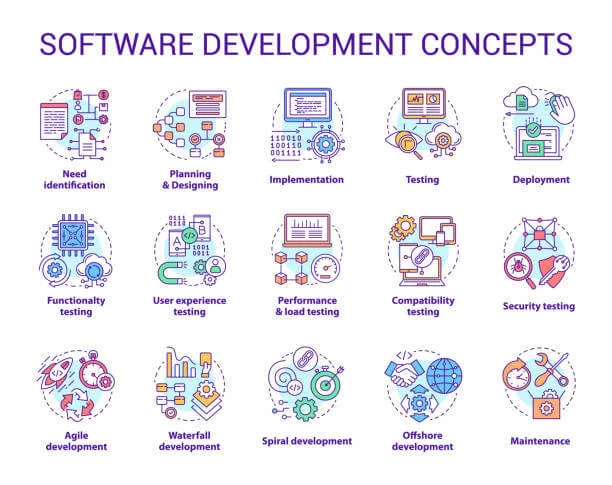
Agile, Waterfall, iterative delivery, and other SDLC models describe how work is organized. They do not tell you whether you need mobile, backend, or embedded expertise. Agile can operate within a fixed budget and deadline by controlling scope; it does not require unlimited time or money.
Prototypes can expose misunderstandings, but defects found in a prototype are not guaranteed to disappear from production. Decide whether prototype code will be discarded or deliberately hardened. Keep testing and maintenance in the plan whichever delivery model you choose.
A practical staffing example
For a hypothetical field technician app, the first workflow is to view assigned jobs, record notes offline, and synchronize them later. The team needs mobile interface work, backend permissions, local storage and conflict handling, an operations dashboard, and tests on representative devices and poor connections.
A full-stack engineer might own the backend and dashboard while a mobile specialist owns device behavior. A product owner defines job states, and QA work covers synchronization, duplicate submissions, lost connectivity, and forbidden access. This is a scope example, not a prescribed headcount or Hapy project result.
Before accepting a proposal, request the named owners, relevant examples, assumptions, exclusions, test evidence, deployment plan, and post-launch support. The right type of development is the set of disciplines needed to deliver and operate the outcome your users actually require.
Map those disciplines and responsibilities into the proposed development engagement before comparing price or team size.
Further questions
What kind of software development does my project need?
Start with the user workflow, devices, data, integrations, and operating constraints. Most products combine several disciplines, such as frontend, backend, mobile, cloud, and QA.
Is full-stack development enough for every project?
No. Full-stack describes work across frontend and backend; specialist mobile, security, data, embedded, or operational requirements may need additional expertise.
How does the SDLC relate to development types?
The SDLC organizes planning, design, building, testing, release, and maintenance. Technical specialties describe the skills needed within that process.