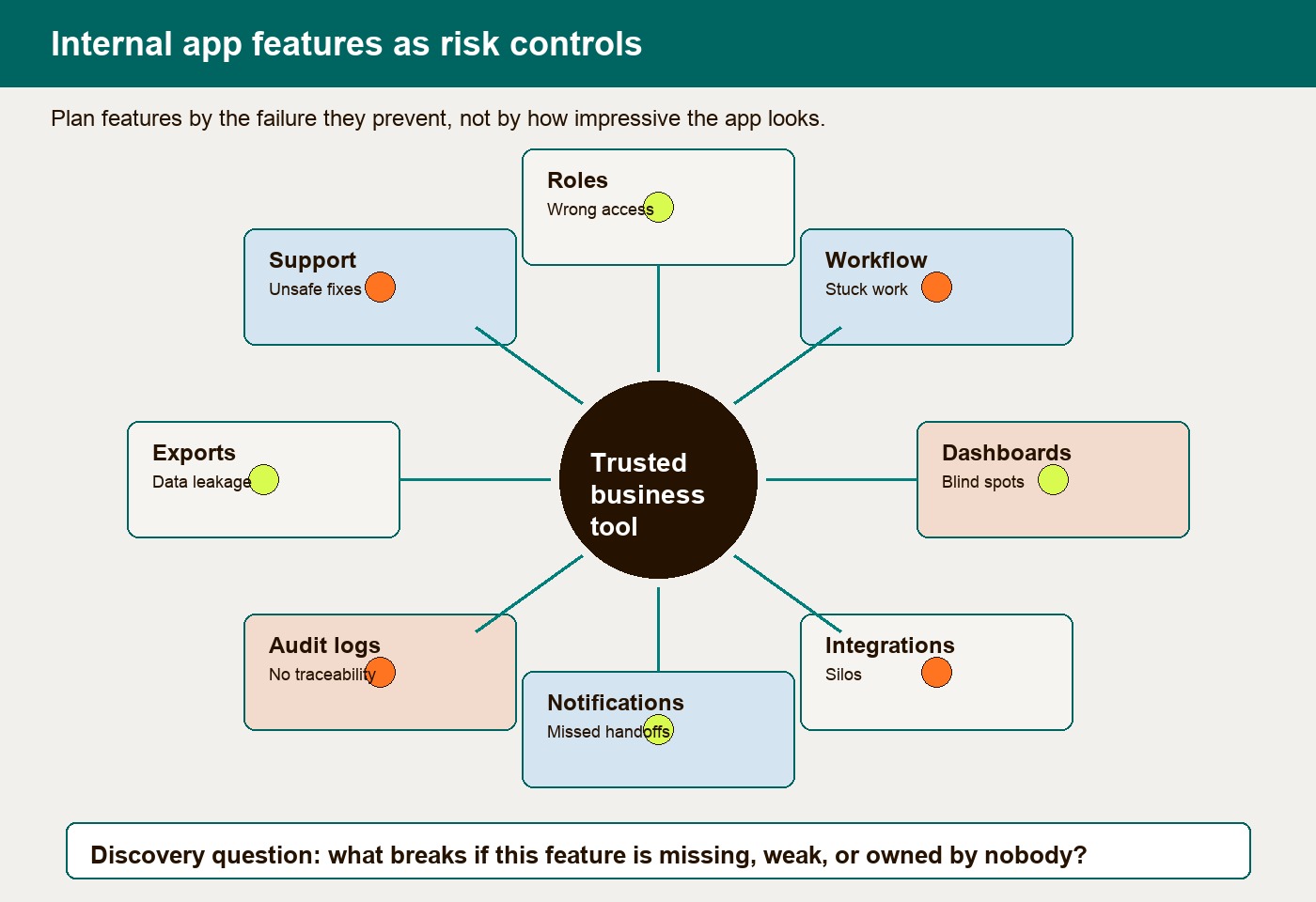
An internal app feature checklist should do more than name screens. It should help the business decide how the tool will control risk, support adoption, and keep work moving after launch. The most important features usually sit around roles, permissions, workflow states, dashboards, reporting, integrations, notifications, audit logs, exports, and support tools.
That framing matters because internal apps often look smaller than they are. A request tracker may touch HR data. A finance approval tool may need segregation of duties. A support console may expose customer records. A dashboard may create decisions that nobody can audit later.
The feature list is not the strategy. The strategy is deciding which controls are needed for the workflow to be trusted. This internal app feature checklist is for founders, operators, and department leaders who are preparing for discovery and want a practical way to turn business web app requirements into buildable scope.
If you are still defining the broader project, pair this with Hapy’s guides to writing a software requirements specification, moving through the software building process, and running technical discovery before development starts.
For tools handling sensitive customer, employee, finance, or vendor data, use the internal web app security checklist to turn the risk level into concrete access, audit, backup, retention, and incident controls.
Start with the risk, not the feature
A business tool should include the features required to make the workflow visible, controlled, usable, and maintainable. That does not mean every internal app needs every enterprise feature. It means every feature should answer a risk question.
Large technology programs show why this discipline matters. McKinsey and the University of Oxford found that many large IT projects struggle with cost, timeline, and value outcomes, including research showing 71% of large IT projects faced cost overruns. A focused internal app is not the same as a large IT transformation, but the pattern is familiar: weak early requirements push hidden work into the expensive part of the build.
Use this first-pass map before discussing features:
| Feature area | Risk it controls | Adoption decision |
|---|---|---|
| Roles and permissions | Wrong people can view, change, approve, or export sensitive data | Users see only the work they are responsible for |
| Workflow states | Work gets stuck, skipped, duplicated, or approved out of order | Teams know what happens next and who owns it |
| Dashboards and reporting | Leaders see lagging numbers but not operational exceptions | Metrics point to action, not just observation |
| Integrations | Teams copy data between systems and create multiple sources of truth | The app fits the existing tool stack |
| Notifications | People miss approvals, handoffs, failures, or deadlines | Alerts are useful enough that people keep them on |
| Audit logs | No one can explain who changed what, when, or why | Users trust the system when something goes wrong |
| Exports | Sensitive data leaves the app without controls | Teams can work with data safely outside the app |
| Support tools | Engineers become the only way to diagnose user problems | Operators can resolve common issues without risky database edits |
This is the simplest way to avoid a generic feature dump. Every custom internal app feature should either reduce operational risk, improve decision quality, shorten a repeated workflow, or make adoption easier.
Roles and permissions decide who can trust the app
Roles and permissions are the first serious business web app requirements to define because they shape almost every later decision. If users can see too much, the app creates privacy and compliance risk. If users can do too little, they work around the app.
Start by listing real user groups, not abstract job titles. A finance manager, branch operator, support lead, sales rep, external auditor, and system admin may all need different views of the same record. The better question is not “who is a manager?” It is “who can view, create, edit, approve, override, export, and administer this workflow?”
For permission structure, role-based access control is still the normal starting point. NIST defines role-based access control as access based on user roles, with permissions often inherited through a role hierarchy. That helps internal apps reflect how work is actually divided inside the business.
For higher-risk workflows, add two controls early:
- Separation of duties: the person who creates a payment, refund, price override, or access request should not be the only person who approves it.
- Least privilege: users should receive the minimum access needed for their role, especially when the app includes customer, employee, financial, or operational data.
Authentication belongs in the same conversation. SAML is common in older enterprise identity environments, while OpenID Connect is a modern identity layer built on OAuth 2.0 that represents ID tokens as JWTs in the OpenID Connect Core specification. The choice is not just technical preference. It affects SSO, onboarding, offboarding, vendor security review, and how quickly access can be removed when someone leaves.
During discovery, document the minimum viable access model:
- Which roles exist at launch?
- Which actions are allowed for each role?
- Which fields are hidden, masked, or read-only?
- Which actions require approval?
- Which admin powers should be rare or temporary?
- Which identity provider must the app support?
Workflow states turn messy work into a controlled path
Workflow states are the backbone of an internal app. They define where a record can be, what can happen next, who can move it, and what the system should do after each move.
For simple tools, this may be enough:
| Workflow | Useful first states |
|---|---|
| Request tracker | Draft, submitted, in review, approved, rejected, completed |
| Finance approval | Created, pending approval, approved, paid, disputed, cancelled |
| Support escalation | Open, assigned, waiting on customer, waiting on internal team, resolved |
| Content operations | Briefed, drafting, editing, approved, scheduled, published |
| Inventory exception | Detected, investigating, corrected, verified, closed |
The risk is hiding workflow logic inside scattered button handlers, spreadsheets, or private team habits. A better internal app makes valid transitions explicit. For example, an invoice may move from “pending approval” to “approved” only if the user has the right permission, the amount is within threshold, and required documents are attached.
For each important transition, define:
- the starting state and ending state;
- who is allowed to trigger it;
- what conditions must be true;
- what data must be captured;
- what notification or downstream action happens afterward;
- what should happen if the transition fails.
This is where a custom internal app earns its keep. It does not just store records. It prevents the business from skipping the controls that make the workflow reliable.
Dashboards and reporting should lead to action
Dashboards are often requested early, but they are easy to overbuild. A dashboard that shows attractive metrics but does not change behavior is decoration. A useful dashboard tells a team what needs attention, why it matters, and what action should happen next.
Separate three reporting needs before design:
| Reporting need | Best format | Planning question |
|---|---|---|
| Operational queue | Table, filters, saved views, bulk actions | What does a user need to act on today? |
| Management dashboard | KPIs, trends, exception counts, cycle time | What does a leader need to monitor weekly? |
| Analytical export | CSV, spreadsheet, warehouse sync, BI connector | What data needs deeper analysis outside the app? |
Internal tools should usually prioritize operational views before executive summaries. The people doing the work need fast search, filters, status counts, error states, and next actions. Leadership needs metrics, but those metrics are only useful if the underlying workflow data is trustworthy.
Accessibility and performance are part of dashboard requirements. The W3C WCAG 2.1 guidelines include keyboard accessibility and rules for character-key shortcuts, which matter in dense internal tools where people navigate quickly all day. Large tables also need server-side pagination, search, and aggregation so users are not waiting for the browser to process thousands of rows.
Before discovery, write down:
- Which decisions should the dashboard support?
- Which metrics are operational versus executive?
- Which filters does each role need daily?
- Which records require drill-down?
- Which actions can be taken directly from the table?
- Which data must be real time, near real time, or periodic?
Integrations decide whether the app becomes another silo
Integrations are where many internal app estimates become fragile. A business team may ask for “CRM sync,” “Slack alerts,” or “finance system integration” as if each one were a checkbox. In reality, each integration has source-of-truth rules, authentication, rate limits, field mapping, failure handling, retries, and support ownership.
Map integrations by business dependency:
| Integration type | Examples | Discovery decision |
|---|---|---|
| System of record | CRM, ERP, HRIS, accounting, inventory | Which system owns each field? |
| Collaboration | Slack, Teams, email, Jira, Basecamp | Which events deserve alerts or tasks? |
| Data and reporting | Warehouse, BI tool, spreadsheet export | Which data should leave the app, and how often? |
| Identity | SSO, directory groups, SCIM | How are users provisioned and removed? |
| Payments or finance | Stripe, bank files, invoicing, procurement | What must be auditable before money moves? |
The most important integration question is ownership. If the internal app updates a customer record, does the CRM remain the source of truth? If finance approves a refund, does the app write back to the accounting system or create a controlled task for someone else? If a sync fails, who sees it and what can they do?
Data privacy also belongs here. Microsoft explains that dynamic data masking limits sensitive data exposure in query results, but should be combined with other controls because users with ad hoc query access may infer underlying values. In business terms: masking is helpful, but it is not a substitute for permissions, logging, encryption, and careful export controls.
Notifications should prevent missed work, not create noise
Notifications are adoption features disguised as technical features. If alerts are too quiet, work gets missed. If alerts are too noisy, people ignore them.
Plan notifications around workflow moments:
- A request needs approval.
- A deadline is approaching.
- A record is stuck in a state too long.
- An integration failed.
- A high-risk action was taken.
- A user was mentioned or assigned.
- A report crossed a threshold.
Then define rules that protect attention:
- Which alerts are urgent?
- Which alerts can be batched?
- Which channels should be used: email, Slack, Teams, SMS, push, or in-app?
- Which roles can change notification preferences?
- Which events should never be muted, such as security or payment failures?
- How will the app avoid notification loops?
For a small internal app, a simple email or Slack notification may be enough. For a critical workflow, the notification system may need queues, retries, delivery status, user preferences, quiet hours, and rate limits. The feature should match the risk.
Audit logs, exports, and support tools protect the system after launch
The most overlooked custom internal app features are the ones users only notice when something goes wrong. Audit logs, safe exports, impersonation, health checks, feature flags, and support utilities rarely look exciting in a prototype. They decide whether the tool can be operated safely.
Audit logs
Audit logs should capture important actions in a structured format: actor, action, target, result, timestamp, and context. That usually includes record changes, approval decisions, permission changes, exports, impersonation sessions, failed access attempts, and admin overrides.
For regulated workflows, audit planning can become a compliance requirement. The HHS summary of the HIPAA Security Rule explains that regulated entities must protect electronic protected health information with administrative, physical, and technical safeguards. Even outside healthcare, the same operating lesson applies: do not wait until after launch to decide what must be traceable.
Exports
Exports are useful, but they move data outside the app’s permission model. Decide who can export, what fields are included, whether sensitive fields are masked, how exports are logged, and whether large exports require approval.
CSV exports also have a specific security issue. OWASP describes CSV Injection, also called formula injection, where untrusted input in a CSV can be interpreted by spreadsheet software as a formula. If your internal app exports user-entered data, export escaping is not a polish item. It is a basic safety control.
Support tools
Support tools reduce the temptation to fix production issues through risky database edits. Depending on the workflow, the app may need:
- user impersonation with ticket reason, time limit, visible warning, and audit trail;
- health checks for the database, queues, integrations, and background jobs;
- sync logs for failed integrations and manual retry buttons;
- feature flags for gradual rollout and quick rollback;
- admin tools for correcting safe fields without engineering intervention;
- diagnostic views that show what happened without exposing unnecessary sensitive data.
These features should not turn the app into a giant control room on day one. But if the workflow is important enough to build, it is important enough to support.
Internal app feature checklist before discovery
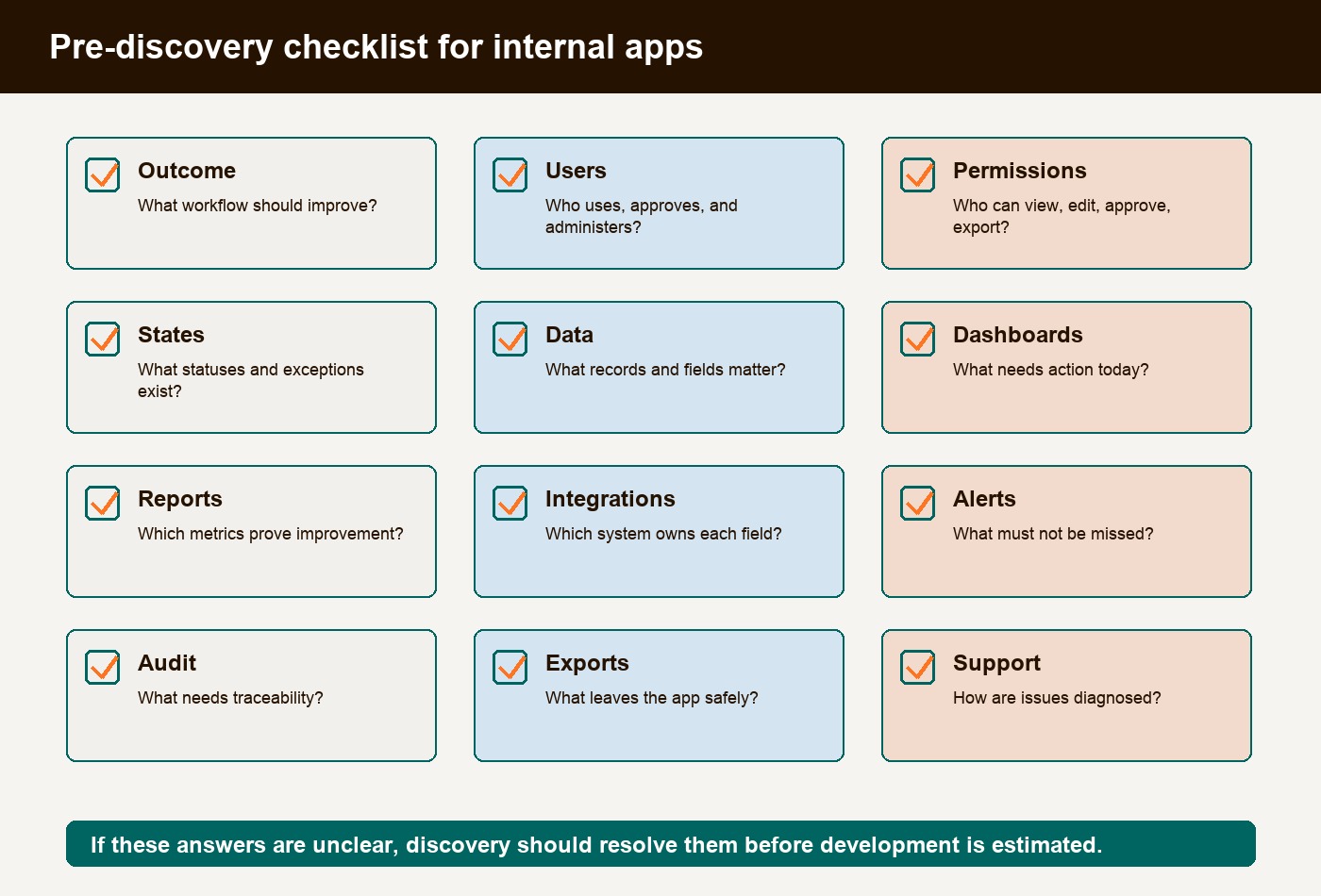
Use this short internal app feature checklist before a discovery call. The goal is not to answer every detail perfectly. The goal is to surface the decisions that affect scope, risk, and adoption.
| Area | Questions to answer before discovery |
|---|---|
| Business outcome | What workflow should become faster, safer, clearer, or more measurable? |
| Users and roles | Who will use the app, who administers it, and who approves sensitive actions? |
| Permissions | Who can view, create, edit, approve, delete, export, override, or manage records? |
| Workflow states | What are the core statuses, transitions, exceptions, and stuck states? |
| Data model | What records, fields, files, comments, relationships, and ownership rules matter? |
| Dashboards | What does each role need to see daily, weekly, and monthly? |
| Reporting | Which metrics show whether the workflow is improving? |
| Integrations | Which systems must the app read from or write to, and which system is the source of truth? |
| Notifications | Which events need alerts, which can be batched, and which should never be muted? |
| Audit logs | Which actions must be traceable for support, compliance, or management review? |
| Exports | Who can export data, what gets masked, and how are exports logged? |
| Support tools | How will operators diagnose issues without direct database edits? |
| Rollout | Which team pilots the tool, how will training work, and what feedback loop exists after launch? |
| Maintenance | Who owns the workflow, requirements, access reviews, and future changes? |
If the checklist produces disagreement, that is useful. Discovery should resolve that disagreement before design and development turn it into expensive rework.
Turn the checklist into requirements
Once the feature areas are clear, turn them into testable requirements. A requirement should say who needs what, under which condition, and how the team will know it works.
Weak requirement:
Users need reporting.
Better requirement:
Operations managers can filter active requests by location, status, owner, and overdue date, then export the filtered view with sensitive customer fields masked.
That second version tells design what screen behavior matters, tells engineering what data and permission logic exists, and tells QA how to test the feature. That is why a practical software requirements specification is useful for internal tools. It turns business intent into an agreement the team can build and test.
From there, the software building process should keep product design, technical planning, implementation, QA, release, and iteration connected. If the app includes deep integrations, sensitive data, complex permissions, AI workflows, or compliance exposure, run technical discovery before estimating the build too tightly.
The right first version is rarely the biggest version. It is the smallest version that gives the team control over the real workflow, enough reporting to see whether it is working, and enough support tooling to operate it without heroics.
FAQ
What is the most important feature in an internal app?
The most important feature is usually the workflow model: the users, states, permissions, transitions, exceptions, and ownership rules that describe how work actually moves. Dashboards, notifications, and reports depend on that model being clear.
Should internal tools be custom-built or built with low-code software?
Use low-code or no-code when the workflow is simple, low-risk, and close to standard CRUD operations. Consider custom development when the workflow has unique permissions, integrations, audit needs, data rules, reporting requirements, or adoption constraints that generic tools handle poorly.
How detailed should business web app requirements be?
Requirements should be detailed enough to test. You do not need a giant binder, but you do need clear users, roles, workflow states, field rules, integrations, reports, non-functional requirements, and acceptance criteria before development starts.
The practical takeaway
An internal app feature checklist is useful only if it helps the business make better scope decisions. Roles, permissions, workflow states, dashboards, reporting, integrations, notifications, audit logs, exports, and support tools are not generic boxes to tick. They are risk-control and adoption decisions.
Before building, ask what would happen if each area were missing. Would the app expose sensitive data? Would work get stuck? Would leadership see the wrong numbers? Would users ignore alerts? Would support need engineering for every fix? Would exports create a data leak?
Those answers define the real scope. Start there, then build the smallest business tool your team can trust. If the workflow needs design and engineering, review Hapy’s business systems automation work against these controls.