CTO job responsibilities during startup onboarding are simple to describe and easy to mishandle: understand the business, inspect the product and code, assess the team, expose technical risk, and turn all of that into an execution plan founders can actually use.
The first 30 days should not become a long discovery theater. A good CTO onboarding process produces decisions: what to stabilize, what to stop, what to ship, what to measure, which vendors to trust, and which technical risks could hurt fundraising, customers, security, or runway.
That matters whether the leader is a full-time CTO, interim CTO, outsourced technical leader, or part-time executive. It matters even more for fractional CTO services, because limited weekly time only works when context, access, decision rights, and priorities are clean from day one.

Use this as a practical SOP, checklist, and playbook for onboarding a startup CTO or fractional CTO in the first month.
If the leadership model is still open, compare this checklist with Hapy’s CTO as a service guide, interim CTO, and outsourced CTO articles before deciding how much ownership the role should carry.
The operating rule for the first 30 days
The first month is not about proving the CTO is smart. It is about building shared reality.
Founders usually bring urgency: ship the roadmap, fix the team, clean up vendors, prepare for investors, reduce cloud cost, or rescue a product that feels slower than it should. The CTO has to respect that urgency without accepting every symptom as the root problem.
The best first-month output is a short operating pack:
- Product context map: users, workflows, revenue model, customer promises, and current roadmap.
- Codebase and architecture review: major systems, dependencies, deployment flow, test coverage, security exposure, and technical debt themes.
- Team review: roles, skill gaps, ownership, communication patterns, morale, and delivery bottlenecks.
- Roadmap reset: what stays, what moves, what gets cut, and what needs technical discovery before commitment.
- Risk register: ranked technical, security, vendor, data, compliance, and delivery risks.
- Vendor assessment: agencies, contractors, SaaS tools, cloud platforms, support obligations, account ownership, and exit risk.
- Metrics baseline: delivery, reliability, quality, cost, team health, and product learning indicators.
That is the job. A CTO who cannot turn discovery into a prioritized operating rhythm is still onboarding when the company needs leadership.
What founders should prepare before the CTO starts
Founders can save a week of confusion by preparing the right material before the CTO arrives. The goal is not to produce perfect documentation. The goal is to remove access friction and expose the decisions that already matter.
Founder pre-start checklist
Prepare this one to two weeks before the start date:
- Product narrative: who the product serves, the problem it solves, the main workflow, and the current business model.
- Current roadmap: committed features, hoped-for features, customer promises, investor promises, and deadlines that cannot move.
- Customer context: top customer complaints, churn reasons, support tickets, sales objections, and enterprise security questions.
- Technical inventory: repositories, environments, architecture diagrams, data model notes, API documentation, deployment steps, and monitoring tools.
- Code access: read-only access first, then elevated access only after ownership and security boundaries are clear.
- Vendor list: agencies, contractors, hosting providers, data tools, analytics tools, AI providers, payment systems, email providers, and support platforms.
- Cloud and SaaS spend: current bills, contract renewal dates, usage dashboards, and any known waste.
- Incident history: outages, major bugs, data issues, security concerns, failed launches, rollback notes, and customer-impacting defects.
- Team context: org chart, individual roles, strengths, frustrations, open roles, compensation constraints, and decision bottlenecks.
- Legal and IP packet: master services agreements, contractor agreements, open-source policy, account ownership, and assignment language for code and documentation.
- Founder constraints: cash runway, fundraising timing, customer deadlines, compliance needs, and risk tolerance.
Do not hide messy information. If the code is brittle, the vendor is underperforming, or the team is frustrated, the CTO needs to know early. A sanitized handoff wastes time and usually creates worse recommendations.
The first 30-day CTO onboarding SOP
This SOP works for a full-time hire, but it is designed for startup speed. For a fractional CTO, compress the meetings, keep documents shorter, and enforce sharper decision windows.
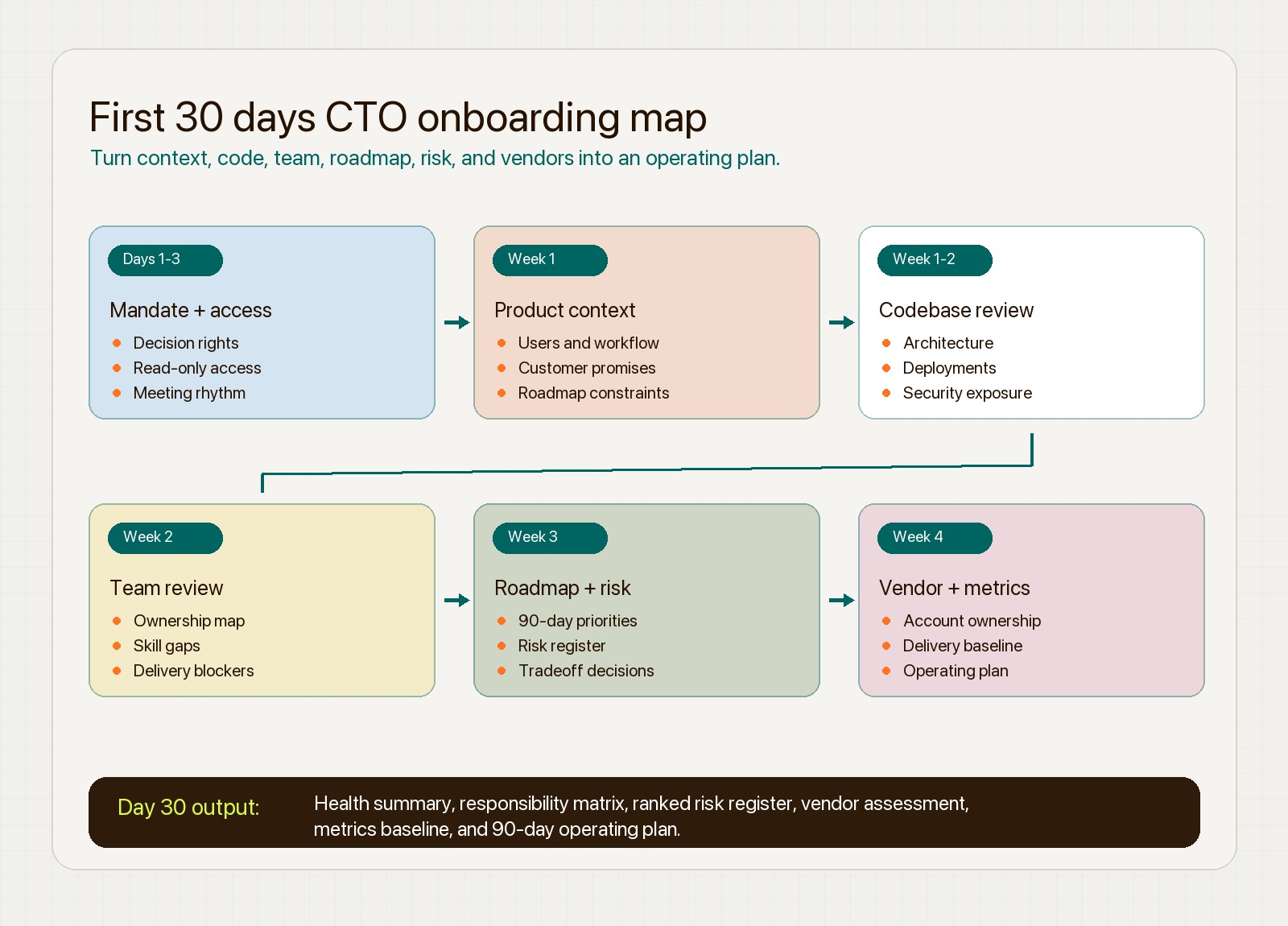
Days 1-3: Mandate, access, and decision rights
The first three days should establish authority without turning the CTO into a bottleneck.
Founder actions:
- Introduce the CTO to the team with a clear mandate.
- Explain what the CTO owns, what founders still own, and where decisions need joint approval.
- Confirm access to repositories, cloud consoles, analytics, ticketing, documentation, monitoring, and vendor accounts.
- Share the top three business outcomes the CTO must support in the next 90 days.
CTO actions:
- Set a meeting rhythm with founders, product, engineering, and vendors.
- Confirm the immediate decision backlog.
- Ask for recent incidents, missed deadlines, security concerns, and unresolved architecture debates.
- Define what will and will not be changed during the first month.
The CTO should leave this phase with one page of decision rights. For example: architecture decisions require CTO approval, roadmap tradeoffs require founder plus CTO approval, vendor contract changes require founder approval, and production access follows a named security process.
Week 1: Product context and business constraints
The first week starts with product context because technology decisions should serve the business model.
Review:
- Core user segments and buyer segments.
- The main product workflow and the moments where users receive value.
- Current activation, retention, revenue, or usage signals.
- Sales commitments and customer deadlines.
- Product analytics gaps.
- Roadmap items tied to fundraising, revenue, compliance, or customer retention.
The CTO should ask blunt questions:
- Which features are already promised?
- Which features are speculative?
- Which part of the roadmap creates the most technical risk?
- Which product assumption is still unproven?
- Which customer workflow breaks trust if it fails?
Output: a product context memo that separates commitments from guesses. This becomes the filter for codebase, team, and roadmap decisions.
Week 1-2: Codebase, infrastructure, and security review
The codebase review should identify risk, not shame the team. Start with structure and flow before judging implementation details.
Review:
- Repository structure and ownership.
- Local setup difficulty.
- Deployment path from commit to production.
- Automated tests, manual QA, staging environments, and rollback process.
- Dependency age, vulnerability management, secrets handling, and permissions.
- Data model, integrations, background jobs, API boundaries, and failure modes.
- Monitoring, alerting, logs, backups, and incident response.
- Cloud cost, scaling assumptions, and unused infrastructure.
For secure software practices, use the NIST Secure Software Development Framework as a vocabulary, not as paperwork. It helps the CTO turn vague concerns like “security needs work” into specific practices around secure design, dependency management, vulnerability response, and release integrity.
Output: a technical health summary with three lists:
- Must fix now: risks that can harm customers, money, security, uptime, or near-term delivery.
- Watch closely: risks that are acceptable for the current stage but need limits.
- Defer deliberately: imperfections that do not matter yet.
That last list is important. A CTO who tries to fix every weakness in the first month will consume runway and trust.
Week 2: Team review and operating rhythm
The team review should answer one question: can this group reliably ship the next stage of the business?
Review:
- Who owns product decisions, technical decisions, QA, releases, infrastructure, and customer-impacting incidents.
- Where engineers wait for decisions.
- Where founders or product managers change scope late.
- Which work is being redone because requirements or architecture are unclear.
- Which engineers are overloaded, underused, or operating without the right support.
- Whether vendors and contractors are managed by outcomes or by activity.
Use one-on-ones, ticket review, pull request review, and ceremony observation. Do not rely only on founder perception. Founders often see missed dates; engineers often see unclear priorities, brittle systems, and invisible support load.
Output: a team responsibility map and a small set of operating changes. Examples include release ownership, weekly architecture review, incident review, sprint intake rules, clearer acceptance criteria, or a named technical lead for each domain.
Startup CTO onboarding checklist
Use this checklist at the end of each week. If an item is unknown, do not mark it complete. Unknowns are allowed. Hidden unknowns are the problem.
| Area | Checklist item | Done when |
|---|---|---|
| Product context | Core customer, workflow, business model, and current roadmap are understood | CTO can explain the product strategy without founder correction |
| Customer commitments | Sales, investor, compliance, and support promises are listed | Roadmap tradeoffs reflect real external obligations |
| Codebase | Repositories, architecture, deployment, tests, and dependencies are reviewed | CTO can name the highest-risk systems and why they matter |
| Infrastructure | Cloud spend, environments, access, backups, monitoring, and alerting are reviewed | Cost and reliability risks are visible |
| Security | Secrets, permissions, dependency risk, data handling, and release controls are reviewed | Immediate security actions have owners |
| Team | Roles, ownership, skill gaps, morale, and bottlenecks are assessed | Founders know what the team can and cannot absorb |
| Roadmap | Current plan is mapped against technical risk and business value | Founder and CTO agree what changes in the next 90 days |
| Vendors | Agencies, contractors, tools, renewals, and account ownership are reviewed | Vendor risk and exit options are known |
| Risk register | Top technical, delivery, security, compliance, vendor, and data risks are ranked | Each top risk has an owner, next action, and review date |
| Metrics | Delivery, quality, reliability, cost, and product learning metrics are baselined | The CTO can evaluate progress without relying on anecdotes |
CTO responsibility matrix for startup onboarding
A responsibility matrix prevents the CTO from becoming either a ceremonial advisor or the person blamed for every technical inconvenience.
| Responsibility | Founder | CTO | Product lead | Engineering lead | Vendor or agency |
|---|---|---|---|---|---|
| Business goals and constraints | Accountable | Consulted | Consulted | Informed | Informed |
| Product roadmap priority | Accountable | Consulted | Responsible | Consulted | Informed |
| Architecture direction | Consulted | Accountable | Informed | Responsible | Consulted |
| Code quality standards | Informed | Accountable | Informed | Responsible | Responsible within scope |
| Release process | Informed | Accountable | Consulted | Responsible | Responsible within scope |
| Security and access controls | Accountable for risk tolerance | Accountable for technical controls | Informed | Responsible | Responsible within scope |
| Vendor assessment | Accountable for commercial decision | Responsible | Consulted | Consulted | Informed |
| Hiring scorecards | Accountable for budget | Responsible | Consulted | Consulted | Informed |
| Technical risk register | Consulted | Accountable | Consulted | Responsible for inputs | Responsible for inputs |
| Investor or enterprise technical diligence | Accountable | Responsible | Consulted | Consulted | Informed |
Treat this as a starting point, not a permanent org chart. In a five-person startup, one person may hold three roles. In a larger startup, the CTO may delegate more execution to engineering managers or tech leads.
Roadmap reset: what changes after the review
The CTO should not rewrite the roadmap in isolation. The job is to expose the technical consequences of the roadmap founders already have.
Classify each roadmap item into one of five buckets:
| Bucket | Meaning | CTO action |
|---|---|---|
| Ship as planned | Valuable and technically understood | Keep scope tight and define release criteria |
| Ship with guardrails | Valuable but risky | Add spike, test plan, monitoring, or phased rollout |
| Split first | Too large or unclear | Break into thinner milestones with customer learning |
| Pause | Not urgent enough for current risk or runway | Remove from active commitment |
| Replace | Wrong solution for the business goal | Propose simpler build, buy, manual, or operational alternative |
This is where a CTO earns trust with founders. The answer is rarely “build less” in the abstract. The useful answer is “build this smaller version first because it proves the customer workflow without forcing us to rebuild billing, permissions, and data migration in the same sprint.”
Build the risk register in week three
A startup risk register should be short enough to review and specific enough to act on. If it becomes a 40-row spreadsheet no one opens, it has failed.
Use the ISO 31000 risk management guidance as the basic frame: identify risk, analyze it, evaluate it, treat it, and monitor it. Then keep the startup version practical.
| Risk | Example | Owner | Severity | Next action | Review date |
|---|---|---|---|---|---|
| Product risk | Roadmap assumes enterprise SSO before a buyer has required it | Founder and product lead | Medium | Validate in sales pipeline | Next roadmap review |
| Architecture risk | One service owns billing, onboarding, and permissions with no clear boundary | CTO | High | Create refactor plan before next major billing change | Two weeks |
| Security risk | Production secrets are shared manually | CTO and engineering lead | High | Move secrets into managed storage and rotate keys | This week |
| Delivery risk | Team accepts work without clear acceptance criteria | Product and engineering lead | Medium | Add intake checklist | Next sprint |
| Vendor risk | Agency controls cloud account and deployment credentials | Founder and CTO | High | Move account ownership to company-controlled accounts | This month |
| Data risk | Analytics events do not match activation or retention questions | Product lead | Medium | Define event taxonomy | Two weeks |
The risk register should drive decisions. If a top risk has no owner or next action, it is only a concern, not a managed risk.
Vendor assessment: what to inspect
Vendor review is one of the most important CTO job responsibilities in a founder-led startup because external teams often made the earliest technical choices.
Review each vendor against six questions:
- Scope: what outcome is the vendor responsible for?
- Quality: how is quality reviewed, tested, and accepted?
- Access: who owns repositories, cloud accounts, domains, credentials, analytics, and production data?
- Continuity: what happens if the vendor leaves, pauses, or raises prices?
- Incentives: does the vendor benefit from complexity, hours, lock-in, or unclear handoff?
- Documentation: could another competent team operate the system within two weeks?
This is where an outsourced CTO or fractional CTO can protect the company from vendor-led architecture. The vendor may be talented and honest, but their incentives are not identical to the startup’s. Someone on the company side needs enough technical authority to audit choices, challenge scope, and own handoff.
Metrics for the first 30 days
Do not evaluate a CTO by hours worked or documents created. Evaluate whether the company has better technical control after the first month.
Use a balanced scorecard:
| Metric | What it tells founders | Good first-month movement |
|---|---|---|
| Deployment frequency | Whether the team can release in small batches | Baseline established and release blockers named |
| Lead time for changes | How long work takes from code to production | Slowest steps identified |
| Change failure rate | Whether releases cause incidents or rollbacks | Defects tied to process or architecture causes |
| Time to restore service | How quickly the team recovers | Incident ownership and monitoring gaps clarified |
| Rework rate | How much work is redone because scope or design was unclear | Top causes named and intake rules improved |
| Bug-to-feature ratio | Whether maintenance is crowding out product progress | Founders can see delivery debt, not just feature output |
| Cloud and tool spend | Whether infrastructure cost matches usage and stage | Waste, renewals, and ownerless tools identified |
| Decision latency | How long engineers wait for product or architecture decisions | Bottlenecks moved to named owners |
The DORA software delivery metrics are useful because they balance delivery speed with stability. DORA now discusses deployment frequency, lead time for changes, change failure rate, failed deployment recovery time, and reliability. For a startup, pair those with product and business metrics so the team does not optimize delivery mechanics while building the wrong thing.
IP, access, and contractor hygiene
If the CTO is fractional, outsourced, or interim, tighten ownership and access before they create or approve important technical work.
Founders should review:
- Written scope and decision authority.
- Confidentiality obligations.
- Present-tense IP assignment for work product.
- Repository, cloud, analytics, domain, and payment account ownership.
- Security policy for credentials and production access.
- Exit support, documentation, and transition expectations.
- Insurance and liability terms where appropriate.
The U.S. Copyright Office explains that a work made for hire has specific ownership rules, and contractor-created work can require careful written agreements. Treat that as a prompt to involve counsel, not as a template to copy. The practical operating rule is simple: the startup should own the accounts, code, documentation, and deployment path it depends on.
What the CTO should deliver by day 30
By day 30, founders should have enough clarity to make better technical decisions for the next quarter.
The CTO should deliver:
- Product context memo.
- Codebase and infrastructure health summary.
- Team responsibility map.
- Vendor assessment.
- Ranked risk register.
- Roadmap recommendation for the next 90 days.
- Metrics baseline.
- Immediate actions with owners and dates.
- A short “do not do yet” list.
That last item matters. A strong CTO does not only create work. They protect the company from expensive work that is premature, poorly scoped, or disconnected from the business.
When a fractional CTO is enough, and when it is not
Fractional leadership works when the company needs senior technical judgment, but not full-time executive coverage. It is a strong fit when the startup has a small team, a founder-led roadmap, an external vendor, an MVP in motion, or a technical diligence need before fundraising.
It becomes weaker when technology is the core proprietary invention, the engineering team needs daily management, compliance requires a named full-time accountable officer, or the CTO is needed in decisions every day.
If the company is still defining the role, compare the broader fractional CTO, startup CTO, CTO responsibilities, and outsourced CTO models before choosing the engagement structure.
Final founder playbook
The real test of CTO job responsibilities is not whether the CTO can explain architecture. The test is whether founders can make better product, hiring, vendor, security, and roadmap decisions after the CTO has entered the room.
For the first 30 days, keep the scope tight:
- Prepare the context before day one.
- Give read-only access first, then expand access deliberately.
- Use product goals to guide technical review.
- Ask for a ranked risk register, not a vague audit.
- Convert roadmap debate into explicit tradeoffs.
- Assign owners for security, releases, vendors, and technical decisions.
- Measure delivery health and product learning together.
- End the month with a 90-day operating plan.
Hapy works with founders who need senior product and technology judgment before a full-time executive hire makes sense. If you are evaluating fractional CTO services, use this checklist to compare whether the engagement will create operating control, not just advice. Review Hapy’s engagements against the responsibilities you need covered.