Germany’s startup ecosystem offers several entry points for B2B software, but ecosystem size does not establish demand for a particular product. This guide combines published context with Hapy’s market-entry hypotheses; the city and sector suggestions are starting points for buyer research, not measured rankings.
Potential entry points include industrial customers, export-heavy companies, AI adoption in manufacturing, dense university spinouts, and large Mittelstand buyers that still run important workflows on fragmented systems. Test procurement time, language needs, privacy expectations, and integration requirements with the particular buyers you intend to serve; these vary by sector and organization.
For B2B SaaS, AI, and Industry 4.0 startups, Germany is a market where “good product” is not enough. The product has to survive local compliance, integration, documentation, procurement, and support reality. A founder entering Germany should ask a practical question before hiring a local sales team: can the product already operate inside a German buyer’s workflow without creating new risk?
If you are comparing DACH markets, pair this Germany view with the Switzerland startup ecosystem guide because Swiss fintech, healthtech, AI, and enterprise SaaS buyers often reward a different trust and compliance posture.
Germany startup ecosystem in 2026: the useful read
The Germany startup ecosystem is strong where software touches serious operational problems: industrial automation, AI tooling, enterprise software, healthtech, climate tech, logistics, fintech infrastructure, cybersecurity, and manufacturing software. It is less forgiving for thin SaaS products that rely on fast outbound, light onboarding, or generic English-only positioning.
Dealroom’s Germany profile shows why the market deserves attention. Germany is listed as Europe’s number eight startup ecosystem by enterprise value, with a public profile showing about $418 billion in startup enterprise value and a deep funnel of pre-seed, seed, Series A, Series B, unicorn, and decacorn companies. The same profile shows Germany’s university-linked startup formation as a major advantage, including more than 2,500 university spinouts and thousands of alumni-founded companies.
The capital story is improving but still selective. Startup Genome’s 2026 European report says Europe’s Series A funding grew 10% from 2024 to 2025, then Q1 2026 ran 56% above the 2025 quarterly average. The same report frames Europe’s recovery as concentrated around AI, defense, deep tech, and strategic sectors, not a broad return to low-friction consumer startup funding.
That matters for German B2B SaaS founders because the strongest buyer pain often sits inside established sectors: manufacturing, finance, logistics, healthcare, insurance, energy, public infrastructure, and professional services. Investors may like AI-native narratives, but German customers usually reward less glamorous execution: better audit trails, cleaner handoffs, reliable integrations, and fewer operational surprises.
Berlin, Munich, and Hamburg without turning this into a ranking
German startups are not concentrated in one city. Berlin, Munich, Hamburg, Stuttgart, Cologne-Bonn, Frankfurt, and the Ruhr each bring different customer networks and technical strengths. For a founder, the right question is not “which city is best?” It is “where are the customers, partners, technical hires, and proof points for this product?”
Berlin is one candidate landing zone for software and AI companies. It has international talent density, strong startup hiring loops, fintech and enterprise software history, and the brand recognition that helps foreign founders start conversations. Dealroom’s hub data shows Berlin-Brandenburg with the largest enterprise value among German sub-national ecosystems, while Startup Genome still treats Berlin as one of Europe’s core startup cities. For B2B product teams, Berlin is often useful for software talent, GTM hiring, investor access, fintech, AI applications, climate software, and commercial pilots with tech-forward buyers.
Munich is a different kind of advantage. It is more deeply tied to engineering, advanced manufacturing, aerospace, robotics, quantum, defense, and industrial customers. Startup Genome calls Munich a standout AI growth story, with AI-native ecosystem value rising 330% since GSER 2024 to $6.2 billion. TUM and UnternehmerTUM are central to that story: TUM reported in February 2026 that UnternehmerTUM was named Europe’s leading startup hub by the Financial Times for the third consecutive year. For industrial AI and deep tech founders, Munich can offer something Berlin cannot always replicate: tight proximity to research, engineering talent, manufacturing customers, and corporate venture-client models.
Hamburg has a clearer logistics, maritime, media, and green technology profile. The Hamburg Startup Monitor 2026 reported 1,540 active startups, 203 new startups founded in 2025, and 22% of Hamburg startups in GreenTech. It also shows the city’s scaleup capital gap: since 2015, Hamburg startups have attracted 3.3 billion euros, compared with 38 billion euros in Berlin and 12 billion euros in Munich. For founders, that does not make Hamburg weaker. It means the product strategy should be specific: logistics software, port and maritime operations, sustainability reporting, industrial supply chains, and B2B products that benefit from local corporate relationships.
What the funding trend actually means for founders
Aggregate funding does not reveal every investor’s mandate or your likelihood of raising. Hapy’s recommendation is to test whether the product belongs in a specific buyer budget: AI that improves a workflow, software that reduces compliance or operating cost, deep tech with credible commercialization paths, or infrastructure that helps large companies modernize without breaking trust.
Founders should read that as a product requirement, not only a fundraising signal. If the deck says “AI for manufacturing” but the product cannot handle plant-level permissions, production data constraints, audit logs, edge deployment questions, and integration with existing MES or ERP workflows, German buyers will see the gap quickly.
The federal support environment also points in the same direction. The EXIST Startup Factories program says ten Startup Factories entered the project phase in 2025, built as public-private partnerships across 126 universities and research institutions and 144 business partners, with around 110 million euros in private financing. These initiatives are designed to increase knowledge-based deep tech spinouts, not produce another wave of generic SaaS landing pages.
For founders, the best use of this ecosystem is practical:
- Use Berlin for software, AI, fintech, product talent, and international hiring.
- Use Munich for deep tech, industrial customers, aerospace, robotics, AI infrastructure, and university-commercialization networks.
- Use Hamburg for logistics, maritime, green tech, media, and supply-chain workflows.
- Use Stuttgart, Baden-Wurttemberg, and the Ruhr when the product needs automotive, robotics, advanced manufacturing, materials, or industrial transformation customers.
Where Germany AI startups and Industry 4.0 meet
Germany AI startups are strongest when AI is attached to a domain-specific workflow. That is a better commercial story than selling “AI” as a feature label.
The appliedAI Institute’s German AI Startup Landscape 2025 counted 935 German AI startups, up 36% from the previous year. The report also notes a strict inclusion logic: startups need a credible business model, team capacity, and internal AI competence. That distinction matters because German enterprise buyers are becoming more skeptical of AI branding without technical depth.
Industry 4.0 gives AI startups a real demand surface. Germany Trade & Invest, citing a Bitkom survey of 555 manufacturing companies with at least 100 employees, reported in April 2026 that 97% of industrial companies use at least one Industrie 4.0 application, 81% consider it very important or indispensable to international competitiveness, 40% already use AI for intelligent control and planning, and 45% use digital twins.
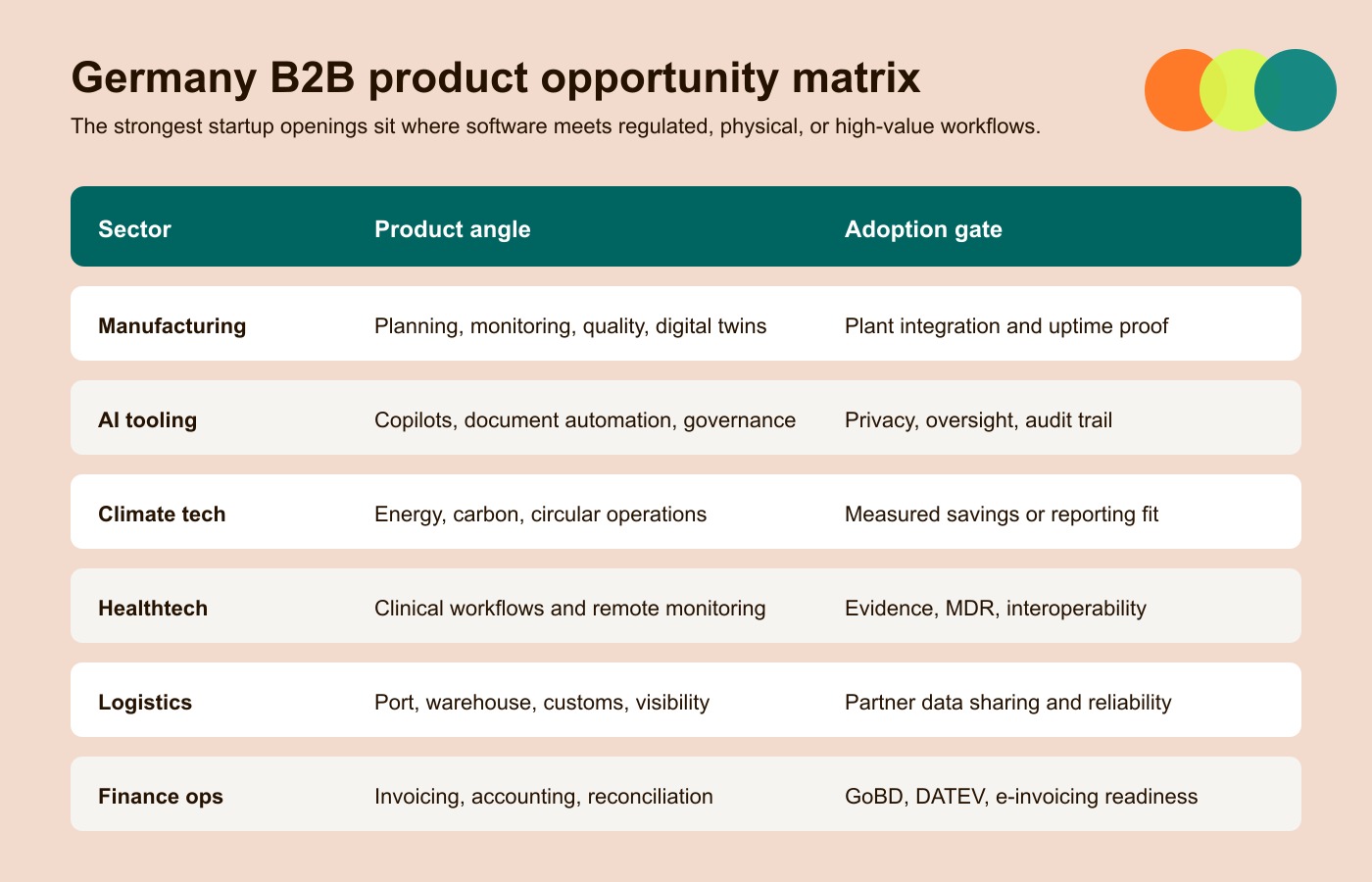
The following are opportunity hypotheses, not evidence of accessible purchase budgets. Validate the workflow, buyer, alternatives, and procurement route before building:
| Sector | Hypothesis to test | Questions to resolve with the target buyer |
|---|---|---|
| Manufacturing software | Production planning, machine monitoring, predictive maintenance, quality inspection, digital twins | Integration with plant systems, uptime, auditability, on-prem or edge options, operator workflows |
| AI tooling | Domain copilots, document automation, data extraction, workflow orchestration, model governance | Data protection, human oversight, explainability, permissions, procurement security evidence |
| Climate tech | Energy optimization, carbon accounting, grid flexibility, industrial efficiency, circularity | Measurable savings, regulatory reporting fit, hardware dependency, payback period |
| Healthtech | Clinical workflow software, remote monitoring, patient engagement, medical operations | Whether medical-device rules apply to the intended use; evidence, hosting, and interoperability requirements |
| Logistics and maritime | Route optimization, customs workflows, port operations, supply-chain visibility | Reliability, ERP/TMS integration, multilingual operations, data sharing across partners |
| Fintech and finance ops | Compliance automation, invoicing, accounting, reconciliation, treasury workflows | Applicable financial rules, accounting-record requirements, buyer export formats, and invoicing scope |
The German B2B SaaS localization checklist
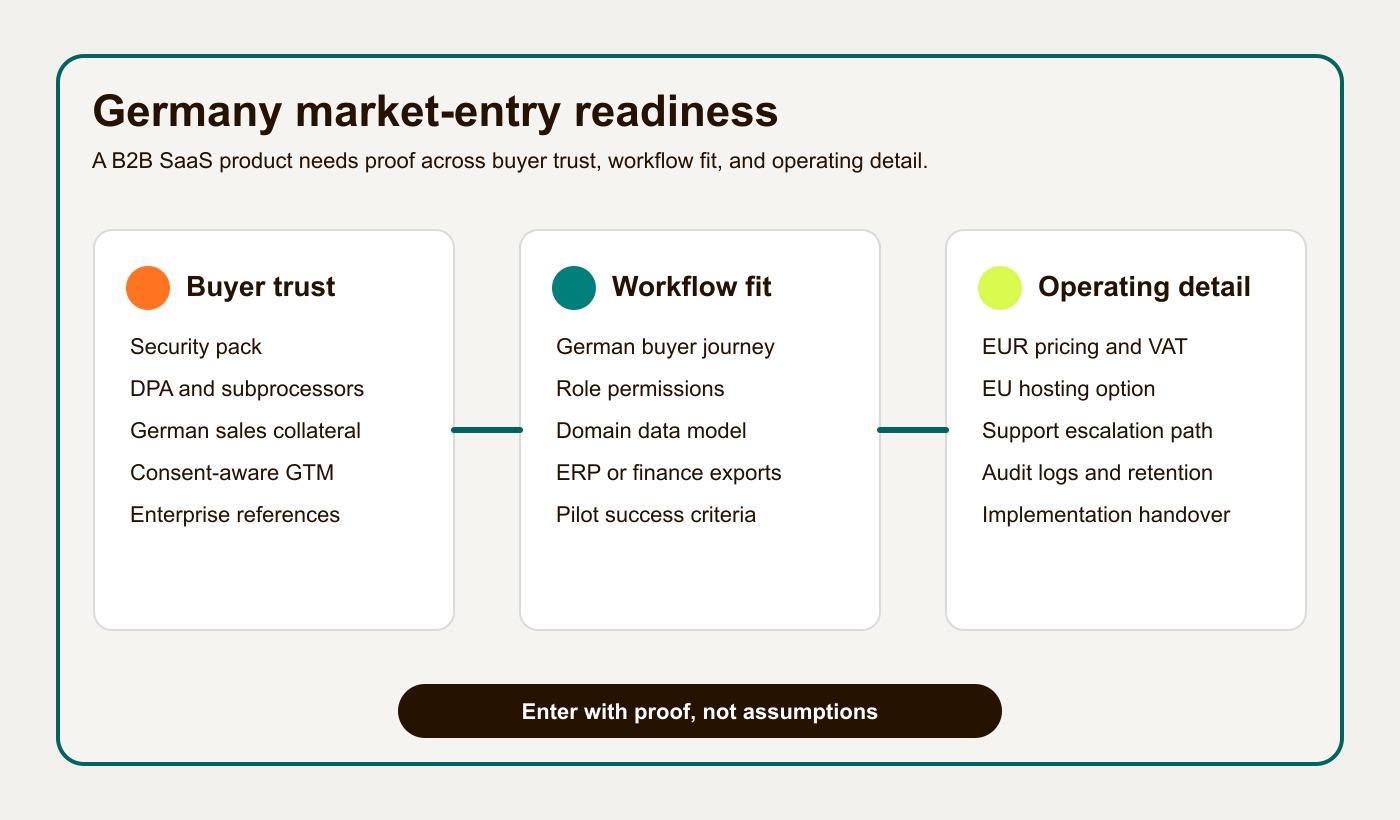
German B2B SaaS localization is not just translation. It is the work of making the product feel legally, operationally, and commercially usable for a German customer.
Use this checklist before treating Germany as an active sales market:
| Area | Readiness question; confirm scope with buyer and specialists |
|---|---|
| Language | German website pages for buyer intent, product docs for admins, sales collateral, onboarding emails, and support macros |
| Procurement | Security pack, DPA, subprocessors list, hosting location, SLA, insurance evidence, accessibility notes, and clear order forms |
| Privacy and consent | Document data flows, purposes, lawful bases, tracking, vendors, and marketing records for legal review |
| Outbound sales | Have German counsel assess the chosen channel, recipient relationship, consent and any exception before outreach |
| Finance workflows | Ask a German tax adviser which invoice, retention, export, and accounting-interface requirements apply |
| Support | German-language support path, local working-hour expectations, escalation rules, and customer success material |
| Product UX | Local date, number, address, tax, currency, and legal notice conventions where relevant |
| Integrations | ERP, CRM, accounting, identity, and data warehouse connectors that match the buyer’s operating stack |
| Hosting and security | EU hosting option, data residency clarity, role-based access, logs, backups, retention settings, and incident process |
| Implementation | Clear discovery, workflow mapping, pilot plan, acceptance criteria, and documented handover |
This is where many international SaaS teams misread the market. They translate the homepage, hire one DACH seller, and assume the product is localized. German buyers often need deeper proof: the product can handle the workflow, the vendor can handle the compliance conversation, and the team will not disappear after the pilot.
If a product still has unclear workflows, weak acceptance criteria, or fragile architecture, fix that before entering Germany. Hapy’s guides to software requirements specification and web application architecture are useful starting points for tightening the product before sales pressure exposes gaps.
Procurement and privacy are product constraints
Scope reviewed September 8, 2026. This is product-planning guidance, not legal or tax advice. Engage German/EU counsel and a tax adviser for the actual product, buyer, data flows, and selling channels. A procurement preference, a contractual requirement, and a statutory obligation are different things.
Start with the European Commission’s EU data-protection framework. Map controller/processor roles, lawful bases, subprocessors, transfers, retention, and rights handling for review. EU hosting alone does not establish compliance, and consent is not the only possible GDPR lawful basis. Marketing channels also require a separate assessment under applicable German rules; do not assume email, social messages, or event follow-up share the same permission requirements.
For invoicing, use the German Finance Ministry’s official e-invoicing FAQ and confirm scope, exceptions, and transition arrangements with a tax adviser. Ask which GoBD-related recordkeeping controls and export formats apply to your role. DATEV is a product ecosystem, not a universal legal requirement; require an actual interface specification and acceptance test where the buyer uses it.
For health or financial workflows, obtain a written applicability assessment before making medical-device, reimbursement, or regulated-service promises. Intended use and the activity performed matter more than the sector label.
Illustrative entry test: approach a small set of manufacturers through an agreed partner introduction, document one planner’s current exception workflow, and ask the budget owner to approve a time-bounded pilot with synthetic or approved data. Compare the current spreadsheet/ERP workaround with the proposed product. Record procurement owner, review steps, integration access, budget, and an agreed success measure. This is a proposed experiment, not a reported German client result.
Founder challenges in Germany
The founder pain points are familiar but sharper in Germany: bureaucracy, slower public administration, conservative procurement, fewer late-stage funding options than the U.S., and a fragmented European go-to-market path. The German Startup Monitor 2025, summarized by Munich Startup, reported concern around capital access, bureaucracy, and the fact that more founders are questioning whether they would start again under current conditions.
International founders should also remember that Germany is not one homogeneous market. A Berlin fintech pilot, a Munich industrial AI deployment, a Hamburg logistics workflow, and a Baden-Wurttemberg manufacturing integration can have very different stakeholders, risk thresholds, and proof requirements.
That can feel heavy, but it creates a moat for founders who do the work. If your product fits the workflow, speaks the buyer’s language, handles privacy and procurement cleanly, and integrates into the existing stack, competitors cannot copy that trust overnight.
German market-entry readiness table
Use this table as a pre-launch discussion aid, not a validated readiness score. The 10–20-account band is an illustrative research workload, not a threshold proving market fit. No number of positive rows overrides an unresolved legal or security gate. A “yes” should mean evidence exists, not only that the team plans to do it later.
| Readiness area | Not ready | Ready enough to test | Strong Germany fit |
|---|---|---|---|
| Customer segment | Broad DACH target with no named workflow | 10-20 target accounts by sector and role | Clear ICP with German buyer pains, budget owner, and internal champion |
| Product workflow | Generic SaaS flow | Localized admin and buyer journey | Domain workflow mapped to German operations, approvals, and exception cases |
| Compliance | Generic GDPR page | DPA, subprocessors, data map, consent posture | Procurement-ready security, privacy, audit, and regulatory evidence |
| Localization | English-only product and sales | German sales collateral and support path | German docs, onboarding, legal notices, product copy, and support coverage |
| Integrations | API exists but no local stack proof | CRM/ERP/accounting integration plan | Tested integrations with likely German systems and export formats |
| Pricing and contracting | USD-only, self-serve only | EUR pricing and enterprise order form | Local procurement terms, invoicing flow, VAT handling, and pilot-to-contract path |
| GTM motion | Cold outbound first | Partner, event, content, and targeted sales motion | Consent-aware pipeline with references, local champions, and repeatable proof |
| Implementation | Product demo only | Pilot plan with success criteria | Discovery, requirements, rollout plan, training, support, and ownership model |
If most rows sit in the first column, Germany is probably too early. If most rows sit in the middle, run focused pilots. If several rows reach the third column, the market can become a defensible expansion path.
Product opportunities worth building for
Hapy’s proposed opportunities below require buyer validation. They are products that reduce real operating friction for buyers with high process complexity.
- Manufacturing intelligence that connects machine data, quality events, maintenance, and production planning without demanding a rip-and-replace project.
- AI workflow tools that help teams review technical documents, RFQs, contracts, compliance evidence, or support tickets with human oversight and traceable decisions.
- Finance operations software that respects German invoice, audit, export, and tax-advisor workflows from the start.
- Climate and energy software that can prove savings or compliance impact, not only reporting polish.
- Healthtech and care software that understands MDR, reimbursement, clinical evidence, patient privacy, and operational adoption.
- Logistics software for port, maritime, customs, warehouse, and cross-border supply-chain workflows.
- Security and governance products for AI adoption, especially where EU AI Act obligations affect documentation, monitoring, and human oversight.
For AI products, the European Commission’s AI Act overview is the official starting point. Obligations depend on the system, role, intended use, and applicable timetable. Confirm the current legal text and any enacted amendments with counsel; do not use a general sector list or a date in a market article as a compliance determination.
What founders should do before entering Germany
Do not start with a city ranking. Start with a product-readiness audit.
Pick one narrow sector, one buyer role, and one operational workflow. Interview German buyers before localizing the entire product. Translate only the assets that matter for trust and conversion. Build a procurement pack before the first serious enterprise call. Map privacy, support, hosting, invoicing, and integration questions into the product backlog. Then run pilots where the success criteria are visible to both the buyer and your team.
If you need a build partner, use the buyer pilot requirements to evaluate Hapy’s MVP development service. If you are building a new product for the Germany startup ecosystem, treat localization as part of product development, not as a marketing task. For custom workflows, the planning discipline matters as much as the code; Hapy’s custom software development services buyer guide can help teams think through discovery, ownership, scope, architecture, and post-launch responsibility before a build becomes expensive.
Evaluate one sector and workflow before treating Germany as a single market. A repeatable pilot-to-purchase route is stronger entry evidence than a city ranking or funding total.