You do not always need an Astro developer. If the project is a small brochure site, a one-off campaign page, or a low-risk blog, a template plus careful setup can be enough. You probably should hire an Astro developer when the site already has SEO value, lead forms, analytics, CMS needs, redirects, integrations, or a marketing team that has to keep publishing after launch.
That is the real decision. Astro is not hard because every page is technical. It is hard because business websites are rarely just pages. They are search assets, content systems, conversion paths, tracking surfaces, and deployment pipelines wearing a visual design.
Astro is a strong choice for marketing sites because its islands architecture renders most of a page as static HTML and only loads JavaScript for interactive components that need it. That can make a site faster, cleaner, and easier to reason about. But speed alone does not protect rankings, forms, redirects, analytics, or the editing workflow.
Use this guide if you are deciding whether to use a template, run a DIY Astro migration, hire an Astro developer, or use a hybrid model where a developer sets the foundation and marketing owns future content.
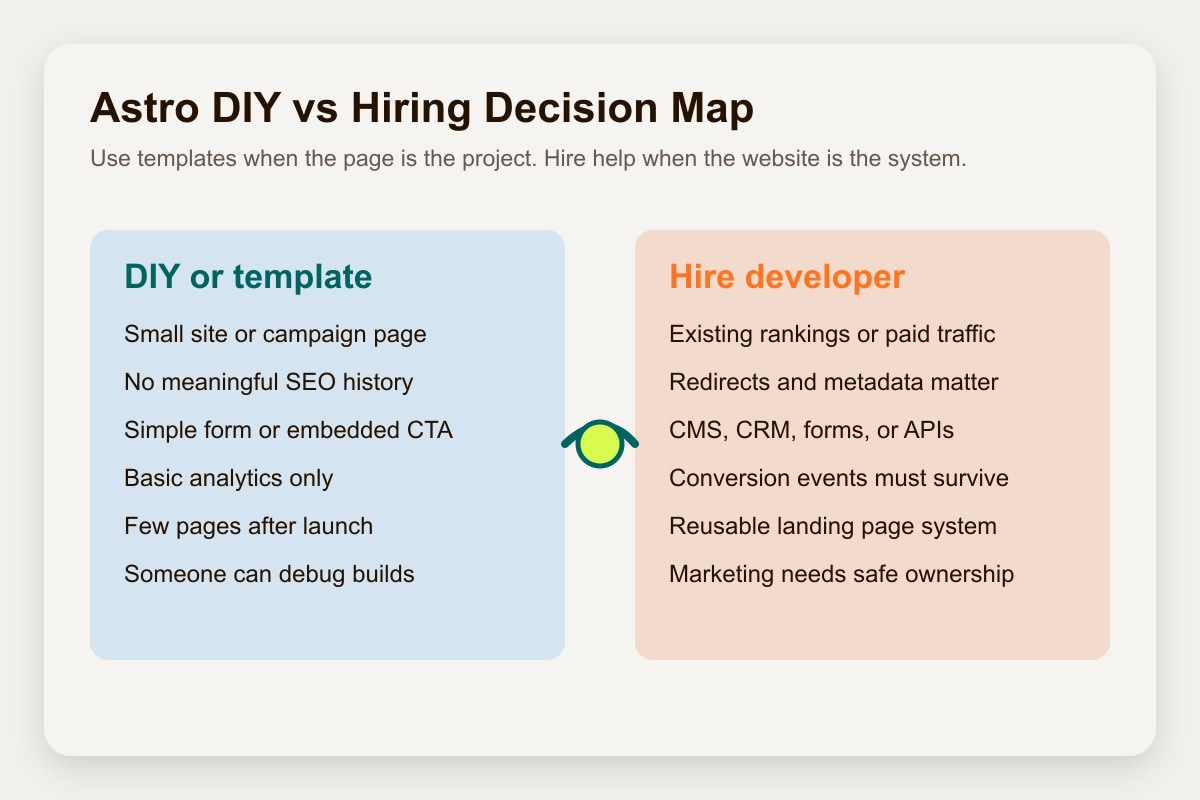
Do you need an Astro developer for this site?
You need an Astro developer when the cost of a broken launch is higher than the cost of getting technical help. That usually means the website already supports sales, recruiting, investor trust, product education, paid campaigns, or organic search.
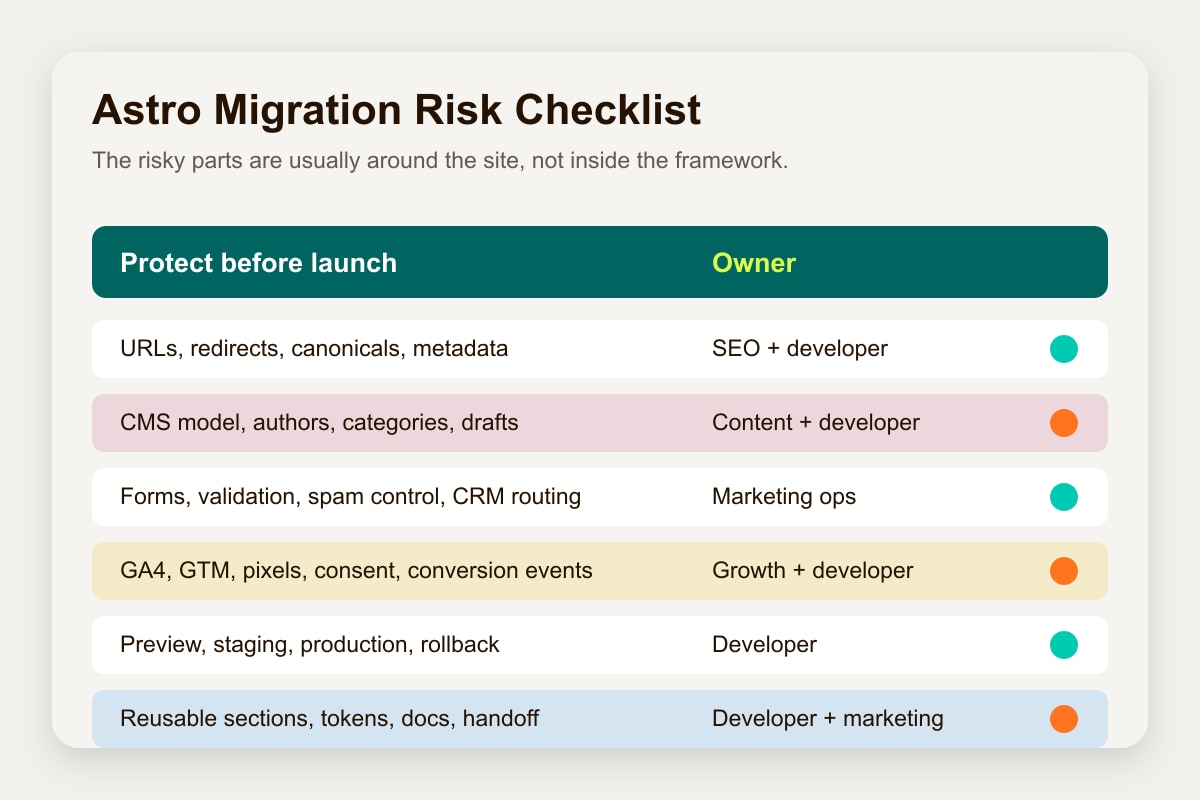
A developer is not only writing Astro components. On a real business website, they are protecting the operating system around the site:
| Area | Why it matters | DIY risk |
|---|---|---|
| SEO | Existing URLs, metadata, canonicals, schema, sitemaps, and internal links carry business value | Rankings drop because the migration treated pages as design files |
| Redirects | Old URLs need clean one-to-one mappings | Legacy URLs return 404s or redirect to irrelevant pages |
| CMS | Marketing needs a safe way to edit content | Every change becomes a code change or a risky copy-paste task |
| Forms | Lead capture needs validation, spam control, routing, and thank-you behavior | The site looks live but leads do not reach sales |
| Analytics | GA4, GTM, pixels, events, consent, and CRM attribution need parity | Reporting breaks and campaign data becomes unreliable |
| Deployment | Builds, previews, environment variables, hosting, and rollbacks need a process | The local site works but production fails |
| Maintainability | Reusable components, design tokens, and content schemas keep future work sane | Every new page creates new CSS, one-off layouts, and hidden debt |
Treat the count as a Hapy planning heuristic, not a hiring threshold. One critical payment or lead integration can justify expert help. Decide by failure consequence, reversibility and the team’s ability to debug and operate each area.
When a marketing team can use an Astro template
Astro templates are a good fit when the project is simple, public, and low-risk. A marketing team can usually start with a template when the site has no meaningful SEO history, no complex content model, and no business-critical integrations.
DIY is most realistic when:
- The site has few templates and manageable content; 10 to 15 pages is only a rough planning example, not a technical limit.
- The content is mostly static copy, images, and simple calls to action.
- There is no large blog, resource library, or multilingual structure.
- The team can accept a simple contact form provider or embedded form.
- Analytics can stay basic: page views, conversion clicks, and one or two form events.
- The site does not need user accounts, payment flows, search, personalization, or private data.
- Someone on the team is comfortable with Git, package installs, local preview, hosting dashboards, and build errors.
The template path is also useful for experiments. If you want to test a new offer, event page, microsite, or founder-led landing page, do not overbuy engineering. Keep the scope narrow, publish quickly, and treat the page as disposable unless it starts producing value.
WordPress became popular partly because non-technical teams could extend it through a large plugin ecosystem. WordPress.org now says its directory includes over 67,000 free plugins. Astro asks for a different tradeoff: less plugin sprawl and a cleaner front end, but more intentional setup around content, forms, and deployment.
When hiring an Astro developer is safer
Hire an Astro developer when the website has business memory. That means URLs already rank, pages already convert, content already lives in a CMS, or sales and marketing already depend on reporting.
The strongest hiring signals are:
- You are migrating from WordPress, Webflow, Framer, Shopify, or a custom legacy site.
- Organic traffic matters and old URLs need redirect mapping.
- The site has a blog, case studies, glossary, authors, categories, or structured content.
- Marketing needs reusable landing page sections, not one-off pages.
- Forms connect to a CRM, email platform, calendar tool, or automation workflow.
- Analytics include conversion events, paid media pixels, consent tools, or attribution rules.
- The site needs schema, Open Graph previews, sitemap discipline, or multilingual SEO.
- You need previews, staging, rollback, or a reliable deployment workflow.
Google’s site move documentation is blunt about the work behind a migration: map URLs, update internal links, keep analytics configured, prepare sitemaps, and plan redirects before the final move. Google specifically recommends URL mapping and permanent redirects when pages move. That is developer work, SEO work, and content operations work at the same time.
Hiring is also safer when performance is tied to revenue. Google’s web.dev summary of Deloitte’s speed research found that a 0.1 second improvement in mobile speed can improve progression through the purchase funnel. For a business site, that does not mean every Astro project automatically makes money. It means page speed is worth treating as commercial infrastructure, not a visual nice-to-have.
What an Astro developer actually does
A good Astro developer for a business website makes the site easier to run after launch. They should not disappear after recreating the homepage.
The practical work includes:
- Build the content model before the templates.
- Decide whether content belongs in Markdown, MDX, Astro content collections, a headless CMS, or a retained existing CMS.
- Create reusable components for page sections marketing will actually need again.
- Preserve metadata, canonicals, schema, image alt text, and social previews.
- Map old URLs to new URLs and test redirects.
- Rebuild forms with validation, spam protection, routing, and success states.
- Recreate analytics events and campaign tracking.
- Set up preview, staging, production deployment, environment variables, and rollback.
- Document how marketing should add pages without breaking the site.
Astro’s content collections can load Markdown, MDX, JSON, YAML, and other structured files with schema validation. That is useful when a business wants a Git-native content system. Astro also has a large CMS ecosystem, and its official docs list many CMS options for Astro. The right choice depends less on the logo and more on how your team edits.
If the marketing team wants visual editing, a headless CMS may be worth the setup. If the team publishes structured articles and landing pages with a few repeatable blocks, content collections plus a lighter editing workflow may be cleaner. If WordPress is still valuable for editors, headless WordPress can be a transition path, but it keeps some WordPress maintenance.
DIY Astro migration: where teams get surprised
The first surprise is that a site can look finished locally and still fail at launch. Production builds are stricter than casual preview work. Missing content fields, inconsistent dates, broken image paths, bad imports, or dynamic routes without the right setup can stop the build or create silent content gaps.
The second surprise is that forms are not just markup. Astro can support forms through API routes or newer server-side patterns, but a business form still needs validation, spam handling, error states, CRM routing, notification rules, and a clear thank-you path. If the form is the main conversion point, do not treat it as a template detail.
The third surprise is analytics parity. A new site can pass a Lighthouse score and still be a bad launch if GA4 events, GTM triggers, pixels, UTMs, consent mode, or CRM attribution stop working. Marketing will feel that pain immediately because campaign reporting becomes unreliable.
The fourth surprise is maintainability. AI coding tools and templates can generate attractive pages quickly, but they often create one-off classes, repeated components, or page-specific logic. That is manageable for three pages. It becomes expensive when the team wants 40 landing pages, a content library, and a brand refresh six months later.
Use a hybrid model when the team wants control
The best answer is often not pure DIY or full outsourcing. A hybrid model works well when marketing wants speed and ownership, but the first setup carries real risk.
In a hybrid Astro project, a developer handles the foundation:
- Project architecture
- Design tokens and reusable components
- CMS or content collection setup
- SEO metadata and schema patterns
- Redirect strategy
- Form and analytics integration
- Hosting, preview, and deployment workflow
- Documentation for future page creation
After that, marketing can use templates, content collections, a CMS, or AI-assisted drafting to create new pages inside guardrails. This gives the team more control without asking non-developers to solve routing, schema, environment variables, build failures, or analytics parity from scratch.
That model also fits how Hapy approaches migrations. Hapy’s Astro migration service and cost page starts with a migration risk audit and explicitly covers SEO, redirects, forms, analytics, integrations, CMS workflow, QA, deployment, and handoff. Request a current scope and quote for your site. An entry offer should not be assumed to cover every migration, integration, content rewrite or support requirement.
If you are migrating from WordPress specifically, use Hapy’s WordPress to Astro migration checklist alongside this hiring decision. The checklist is about the migration mechanics. This article is about deciding who should own the work.
If the scope still feels unclear, compare this with the Astro migration timeline and the partial Astro migration guide before hiring for a full rebuild.
Short decision checklist
Use this before you hire, buy a template, or start a DIY Astro migration:
| Question | If yes, lean DIY | If yes, hire help |
|---|---|---|
| Is the site mostly static and new? | Yes | No |
| Does the site already get meaningful organic traffic? | No | Yes |
| Are old URLs, redirects, and metadata important? | No | Yes |
| Can the team edit safely without a visual CMS? | Yes | No |
| Are forms simple and low-risk? | Yes | No |
| Do analytics events affect sales or ad decisions? | No | Yes |
| Does the site need schema, multilingual pages, or complex content types? | No | Yes |
| Can someone debug build, hosting, and dependency issues? | Yes | No |
| Will marketing need many new pages after launch? | Maybe | Yes |
The simplest rule: DIY the page if the page is the project. Hire an Astro developer if the website is the system.
How to scope an Astro developer before hiring
Do not ask only for an hourly rate. Ask for the risks they will own.
Give the developer or agency:
- The current site URL
- The pages that drive traffic or leads
- A list of required forms and integrations
- Analytics and conversion events that must survive launch
- CMS needs and who edits content
- SEO constraints, including URLs, metadata, schema, and redirects
- Launch deadline and rollback tolerance
- Examples of pages marketing needs to create after launch
Then ask for a proposal that separates audit, migration, build, QA, launch, and handoff. You want to see assumptions, exclusions, ownership, and post-launch support. A serious Astro developer will talk about content models and migration risk before promising a fast redesign.
Google’s structured data guidance says structured data gives Search explicit clues about a page’s meaning. That matters during an Astro migration because schema, authorship, breadcrumbs, FAQ markup, and organization metadata can get lost when templates are rebuilt. Preserve the structured meaning of the site, not only the visible layout.
Astro can be deployed across many static and on-demand hosts, including Cloudflare, Netlify, Vercel, GitHub Pages, AWS, and others listed in the official Astro deployment docs. The host decision should follow the site: static pages, form strategy, preview needs, server routes, image handling, traffic, and rollback requirements.
The bottom line
If you are asking “do you need an Astro developer?” the honest answer is: not for every Astro site, yes for most serious business migrations.
Use templates when the site is small, new, mostly static, and easy to replace. Hire an Astro developer when the site already has search equity, lead flow, reporting, integrations, CMS needs, or a team that must maintain it without breaking the foundation.
Astro can make a marketing site faster and cleaner. The developer’s job is to make sure the move also protects the parts of the website the business already depends on.