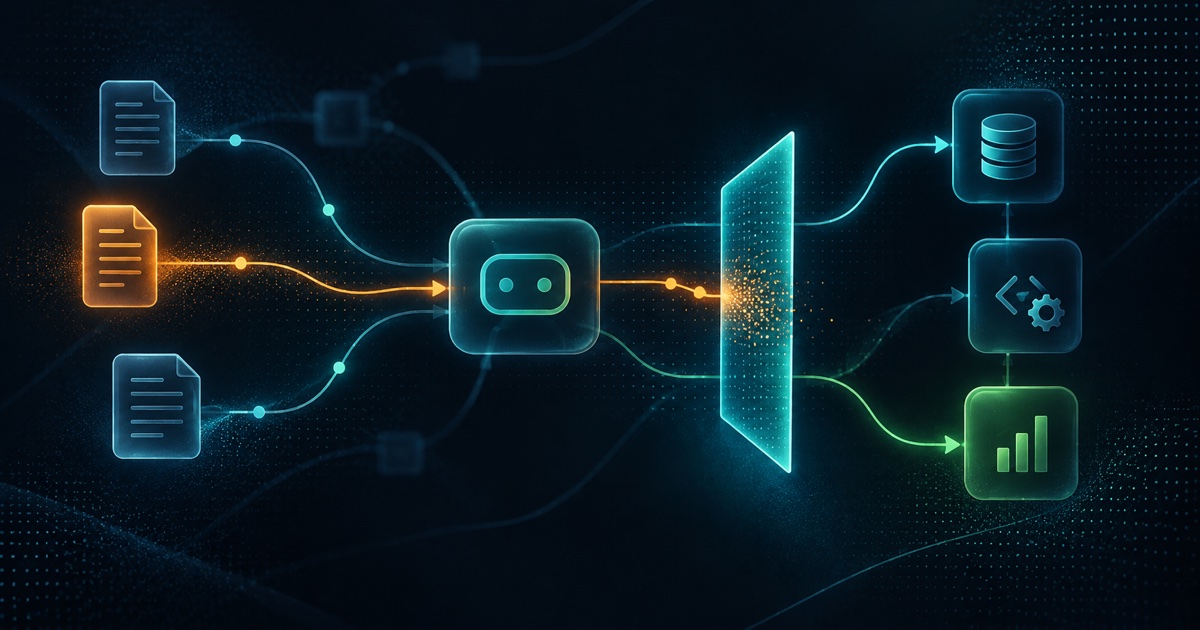
A custom employee portal is worth considering when staff need one reliable place to start and finish internal work, not just another destination to check. The point is not to replace every system. The point is to create a usable front door across onboarding, requests, documents, approvals, reporting, schedules, and announcements.
That distinction matters. Many companies already have a HRIS, SharePoint, Slack, Teams, Notion, Google Drive, spreadsheets, project tools, and department-specific software. Adding “employee portal software” on top of that mess can make the problem worse if it becomes one more login.
The better question is: should the business standardize on an existing tool, or does it need a custom portal that connects the tools behind the scenes?
Use this article as a decision guide. It is written for founders, operators, HR leaders, IT teams, and department heads who are comparing SharePoint, HRIS portals, Notion-style workspaces, intranet platforms, and custom employee portal development.
What a custom employee portal should actually do
A custom employee portal should make recurring staff workflows easier to complete, easier to govern, and easier to measure. It should not be a prettier homepage with links to the same scattered systems.
The strongest portal use cases usually sit between departments:
| Use case | What the portal centralizes | Why it matters |
|---|---|---|
| Onboarding | New-hire checklists, documents, policy acknowledgments, training tasks, equipment requests, account setup | Reduces day-one confusion and makes required steps auditable |
| Requests | PTO, HR questions, IT support, access requests, procurement, expenses, benefits changes | Gives staff one intake point and routes work to the right owner |
| Documents | Policies, templates, tax forms, training material, SOPs, employee handbooks | Prevents outdated files and makes search less dependent on memory |
| Approvals | Manager approvals, finance approvals, compliance reviews, contract signoffs | Removes approval work from email threads and makes status visible |
| Reporting | Operational dashboards, compliance status, training completion, service volumes, timesheets | Gives leaders a current view without manual spreadsheet assembly |
| Schedules | Rosters, shift changes, timesheets, leave coverage, frontline updates | Helps deskless and distributed teams work from the same plan |
| Announcements | Company news, policy updates, location-specific notices, role-specific alerts | Reduces broad email blasts and targets information by audience |
The portal becomes valuable when these workflows share people, data, and permissions. For example, onboarding may touch HR, IT, finance, facilities, legal, training, and a hiring manager. A simple checklist can live in Notion. A governed onboarding workflow that provisions accounts, collects signed documents, triggers equipment requests, assigns training, tracks completion, and restricts sensitive documents by role usually needs a stronger system design.
This is where a portal overlaps with business process automation. The workflow should come first. The portal is only useful if it removes handoffs, duplicate entry, status chasing, or permission ambiguity.
When staff need one system instead of more tools
The signal is not “we have too many apps.” Most growing companies do. The signal is that staff cannot complete common work without switching context, asking where something lives, or recreating data from one system inside another.
Harvard Business Review has covered the productivity cost of toggling between workplace applications, and the pattern is familiar inside operations: work is not only slowed by bad tools, but by the effort of remembering which tool owns which part of the job.
A custom employee portal starts to make sense when several of these are true:
- Employees need three or more systems to complete one routine workflow.
- Managers approve work from email, chat, spreadsheets, and backend tools with no single queue.
- HR, IT, operations, finance, and compliance each maintain separate intake forms.
- Staff search multiple document stores before finding the current policy or template.
- Reporting depends on exports, manual cleanup, and side spreadsheets.
- Access rules differ by role, department, location, client, or employment type.
- Deskless or shift-based employees cannot reliably use desktop-first systems.
- The company has outgrown informal admin work but does not need a full ERP replacement.
The important word is routine. If a process happens once a year, a custom portal may be overkill. If a process happens every day across many roles, the friction compounds. That is where a portal can reduce operating drag.
Custom employee portal vs SharePoint, HRIS, and Notion-style tools
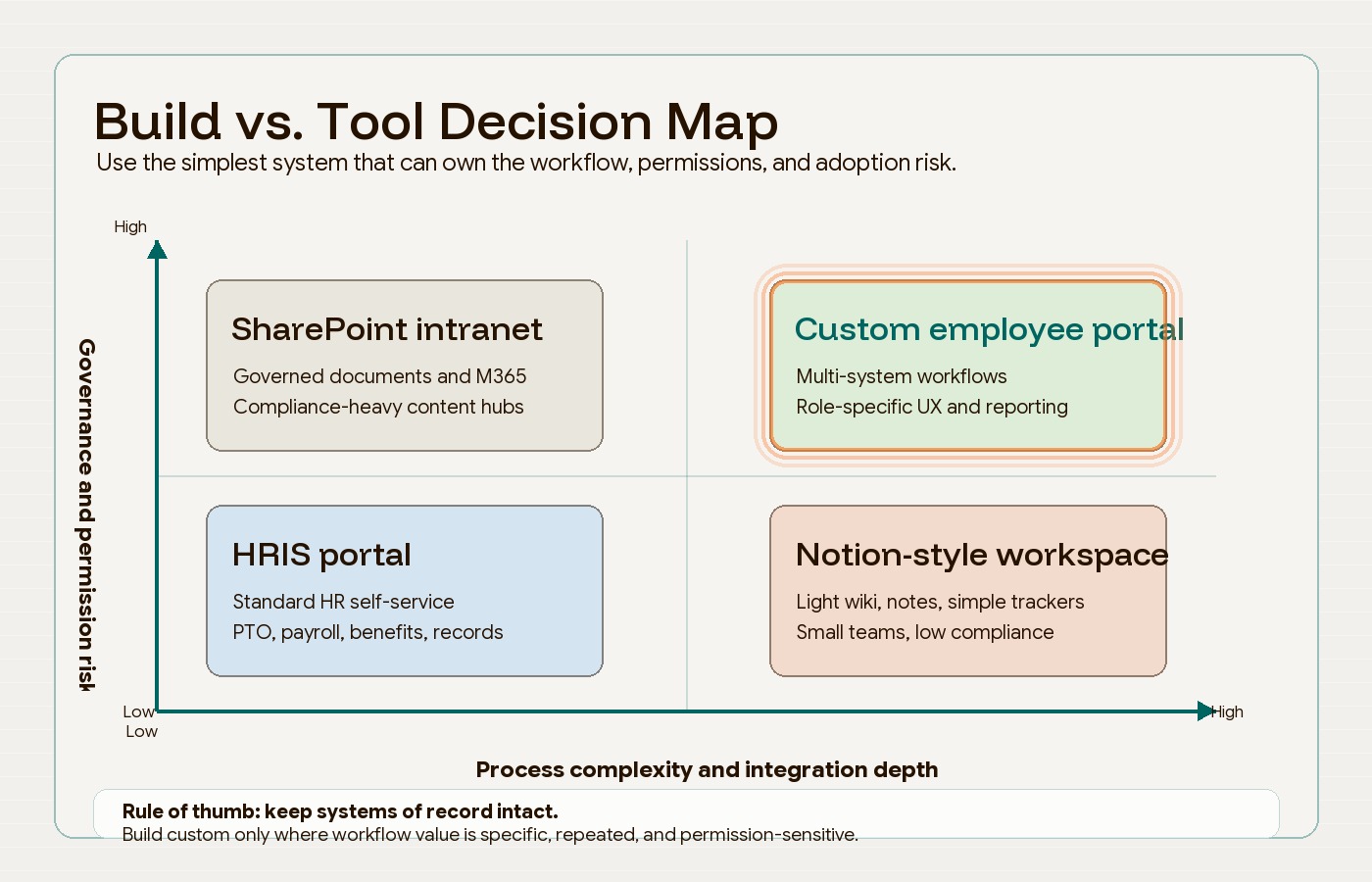
A custom employee portal is not automatically better than SharePoint, a HRIS, or Notion. Each option has a job. The comparison below is a set of evaluation questions, not a finding that a particular edition lacks a feature. Capabilities depend on plan, configuration, integrations and administrator skill. Check the actual licensed setup before funding custom work.
| Option | Best fit | Where it breaks down |
|---|---|---|
| Notion-style workspace | Small teams, internal notes, lightweight knowledge bases, simple databases, fast team documentation | Check sharing inheritance, guest access, database permissions, audit needs and the discipline required to maintain structure |
| SharePoint intranet | Document management, Microsoft 365 collaboration, internal publishing, governed content, regulated document libraries | Test workflow usability, administration, indexed list queries and handoffs across the licensed Microsoft tools |
| HRIS portal | Payroll, benefits, PTO, employee records, standard onboarding, compliance documents | Check the chosen HRIS’s non-HR modules, workflow APIs, licensing and approval configuration |
| Custom portal | Multi-system workflows, role-specific staff experience, complex permissions, operational reporting, proprietary processes | Higher upfront design and engineering cost; ongoing ownership, maintenance, security, and adoption work required |
SharePoint deserves a fair reading. It is often the right answer when the business is already deep in Microsoft 365 and the main need is governed documents, intranet pages, search, and Microsoft-native collaboration. It also has mature permission and compliance tooling.
But SharePoint is not a magic operating layer. Microsoft’s own guidance on the SharePoint List View Threshold shows that large lists and libraries need careful indexing, filtering, and structure. That is manageable for good SharePoint administrators. It is a warning sign when the business is trying to bend SharePoint into a high-volume workflow product.
HRIS portals have a different strength. They are good at standard HR transactions because the data model is already built for employee records, PTO, payroll, benefits, and compliance. Test whether the selected HRIS and its integrations can support a single experience across HR, IT, finance, operations and reporting before ruling it out.
Notion-style tools are useful when a team needs speed and flexibility. Review Notion’s sharing and permissions documentation against your actual access scenarios. The Notion permission entry point was checked September 8, 2026. Neither a product category nor a custom build is a security assurance.
The custom route is strongest when the process is specific enough to create business value and repetitive enough to justify the cost.
The custom route works best as an integration layer
Good employee portal development usually does not mean rebuilding Workday, SAP, Rippling, SharePoint, ServiceNow, Salesforce, or the finance system from scratch. That would be expensive and unnecessary.
The cleaner architecture is a unified experience layer:
- The portal owns the staff-facing workflow.
- Backend systems remain the source of record.
- APIs move data between the portal and those systems.
- Identity and permissions control what each user can see or do.
- Reporting pulls from governed data instead of manual exports.
This matters because staff do not care which system is technically responsible for a request. They care whether they can submit it, track it, approve it, or find the answer without asking three people.
For example, a manager might open one portal and see pending leave requests from the HRIS, purchase approvals from finance, access requests from IT, training exceptions from compliance, and schedule changes from operations. The portal does not need to own every database. It needs to make the work coherent.
That is also the difference between an employee portal and a collection of internal tools. A narrow tool solves one workflow. A portal becomes the daily operating layer across several workflows. Hapy’s guide to custom ERP development vs internal tools is useful when the team is deciding how broad that operating layer should become.
Adoption is the first major risk
The biggest employee portal risk is not technical. It is adoption.
If the portal does not make work easier on day one, employees will route around it. They will keep using Slack messages, forwarded emails, old spreadsheets, saved Drive links, and direct requests to the person they trust. The organization then owns both the old process and the new platform.
Adoption improves when the first release solves a visible pain:
- One place to find the current policy or template.
- One intake form for HR, IT, facilities, or finance requests.
- One approvals queue for managers.
- One onboarding checklist for new hires and internal owners.
- One schedule view for employees who are not sitting at a desk.
- One dashboard that replaces a recurring manual report.
Do not start with the full dream portal. Start with the workflow people already complain about. Then measure whether the portal reduces tickets, follow-up messages, duplicate forms, missing approvals, document search time, or manual reporting effort.
This is where a phased MVP rollout is useful. A first release might include directory, announcements, document search, a request center, and one high-volume approval workflow. Later releases can add deeper integrations, reporting, shift planning, mobile features, and more complex automation.
The adoption rule is blunt: if the portal asks employees to do more work for leadership’s reporting benefit, it will struggle. If it gives employees a faster path to what they already need, it has a chance.
Permissions are the second major risk
Permissions can make or break staff portal software. A portal often sits in front of sensitive employee records, operational data, financial requests, legal documents, customer information, and internal performance data. If the permission model is vague, the portal becomes a liability.
At minimum, a serious portal needs:
- Single sign-on through the company’s identity provider.
- Role-based access control by job role, team, location, and seniority.
- Field-level or document-level restrictions where sensitive data is exposed.
- Audit logs for approvals, exports, permission changes, and admin actions.
- Clear ownership for every workflow, document collection, and data source.
- A review process for joiners, movers, leavers, contractors, and temporary access.
The architecture should follow the principle of least privilege: employees see what they need to do their work, not everything the portal can technically reach.
For custom builds, security should be part of the delivery process rather than a final checklist. NIST’s Secure Software Development Framework is useful because it treats secure development as a set of practices that can be integrated into the software lifecycle and used in supplier conversations. That is the right posture for portals because the business is buying not only screens, but a governed access point into internal systems.
Accessibility belongs in the same risk conversation. An employee portal is mandatory workplace infrastructure, so it should work for employees using keyboards, screen readers, mobile devices, different zoom levels, and assistive settings. The W3C Web Content Accessibility Guidelines give teams a practical standard to design and test against.
What to build first
The first version of a custom employee portal should prove that the system can reduce friction without trying to absorb the whole company.
A sensible first release often includes:
- Identity and roles: SSO, employee profile data, departments, locations, and permission groups.
- Navigation and search: a staff homepage, document search, important links, and role-specific shortcuts.
- Request center: one or two high-volume request types with routing, status, and notifications.
- Approvals inbox: a single manager queue for the selected workflows.
- Content governance: owners, review dates, version control, and archive rules for key documents.
- Reporting baseline: simple dashboards for request volume, completion time, overdue items, adoption, and exceptions.
- Feedback loop: a way for employees to flag confusing pages, broken links, missing documents, and workflow gaps.
This is enough to learn whether the portal is becoming useful. It also keeps the first build small enough to adjust.
Avoid starting with every possible feature: social feeds, AI assistants, advanced analytics, employee recognition, org charts, custom CMS, learning management, shift scheduling, document automation, and full mobile app support. Some may be valuable later. In phase one, too many features can hide whether the core workflow actually works.
How to decide whether custom is worth it
Custom employee portal development is worth it when the operational savings, control, and staff experience justify the cost of building and maintaining software.
Use this decision test:
| Question | If yes, custom becomes more likely |
|---|---|
| Does the workflow cross HR, IT, finance, operations, compliance, or delivery? | A portal can coordinate ownership across teams |
| Do employees need different views based on role, location, department, client, or employment type? | Custom permissions and UX may matter |
| Is the process high-volume or business-critical? | Small efficiency gains can compound |
| Are existing tools forcing manual exports, duplicate entry, or email approvals? | Integration and automation may pay back the build |
| Does leadership need real-time reporting instead of spreadsheet assembly? | A portal can create cleaner operational visibility |
| Are standard tools making employees work around the process? | A custom front end may fit the process better |
| Will the company maintain the system after launch? | Custom only works when ownership is real |
If most answers are no, use the simpler tool. A clean SharePoint intranet, a better HRIS setup, a Notion workspace, or a no-code internal tool may be enough.
If most answers are yes, the issue is probably not “which portal product should we buy?” It is “which workflows should become one operating layer, and which systems should stay behind it?”
The Hapy view
A custom employee portal should reduce operational drag. It should not become a prestige build, an intranet redesign, or a new wrapper around unresolved process confusion.
The best portal projects start with a workflow audit: what staff need to do, which tools they touch, where approvals stall, where documents go stale, which reports are manually assembled, and where permissions are risky. From there, the team can decide what belongs in SharePoint, what belongs in the HRIS, what should stay as a narrow internal tool, and what deserves a custom portal.
That is the practical path: simplify before building, integrate before replacing, and design for adoption before adding features.
If the problem is scattered tools, manual handoffs, weak visibility, and internal workflows that no off-the-shelf product quite fits, a custom employee portal can be the right move. If the problem is only messy content or underused software, fix the existing system first.
Hapy Co helps teams with this kind of Business Systems & Automation work: mapping the process, cleaning up the operating logic, and building internal systems that people can actually use.