SaaS pricing validation is the discipline of testing what customers understand, value, and will pay for before the team builds more software. It is not only a finance exercise. Pricing is a product decision because it forces a hard question: which customer gets enough value from this capability to pay for it, expand usage, and accept the operational tradeoffs that come with it?
That question should come before another quarter of feature accumulation. A weak package can make a strong product look confusing. A poor billing metric can turn heavy usage into margin pressure. A pricing page can hide the real problem: customers do not understand the upgrade path, or the product is charging for the wrong unit of value.
For SaaS founders and PMs, the goal is not to find a perfect price once. The goal is to build a repeatable validation loop that connects packaging, product scope, support cost, and revenue expansion. If the product still needs basic demand evidence, start with Hapy’s guide to SaaS product-market fit and the SaaS business model. If the product is still pre-build, pricing validation belongs inside the MVP development process, not after it.
When to Test SaaS Pricing
Test SaaS pricing whenever the product roadmap, customer segment, cost structure, or sales motion changes. Do not wait until the pricing page is live. By then, the team may have already built features that customers treat as table stakes, locked premium functionality behind the wrong tier, or chosen a billing metric that does not match product value.
The strongest moments to test are:
- Before building a major feature that is supposed to justify a higher tier.
- Before launching the first paid plan or moving from free to paid.
- Before adding AI workflows, data processing, integrations, or other variable-cost capabilities.
- Before changing from seat-based to usage-based pricing.
- When sales calls produce repeated discounting, confusion, or “send me the feature list” behavior.
- When existing customers use one feature heavily but do not upgrade.
- When support cost rises faster than revenue from the segment creating the work.
Pricing validation is especially important for B2B SaaS because the product, buyer, and user are often different people. A support manager may love automation. Finance may approve the budget. IT may care about security controls. A pricing package has to make sense across all three.
What Pricing Validation Should Prove
A useful pricing test should prove more than “will someone click this button?” It should isolate the specific monetization risk.
| Validation Question | What It Reveals | Product Decision It Should Change |
|---|---|---|
| Which customer segment feels the pain most sharply? | Whether the ICP is real enough to price around | What to build first and what to ignore |
| Which outcome does the buyer pay for? | Whether value comes from revenue, savings, risk reduction, or speed | How to position features and tiers |
| Which feature creates an upgrade reason? | Whether the package has a real fence | What belongs in Starter, Growth, or Enterprise |
| Which billing metric scales with value? | Whether seats, usage, credits, locations, or transactions fit | How billing and product limits should be designed |
| Which objection appears first? | Whether friction is price, package, metric, trust, or timing | What to change before more engineering work |
This matters because common SaaS pricing failures look similar from a dashboard but require different fixes. Low conversion may mean the entry price is too high. It may also mean the free plan gives away the value moment. Flat expansion may mean the product has no premium trigger. It may also mean the trigger exists but is fenced in a way buyers do not understand.
Start With Packaging, Not the Price Point
SaaS packaging is the structure that tells customers which product version is for them. The price is only one part of that system. Stripe’s guide to SaaS pricing and packaging strategy frames the work around pricing models, value metrics, package design, and iteration, which is the right order for most early and growth-stage teams.
A good package usually answers four questions:
| Packaging Element | Practical Test |
|---|---|
| Segment | Can a buyer quickly tell which tier is meant for their company? |
| Value metric | Does the bill rise when customer value or vendor cost rises? |
| Fence | Is there a clear reason to upgrade before the account becomes painful to support? |
| Promise | Does each tier describe an outcome, not just a pile of features? |
For a B2B SaaS product, a simple tier structure might look like this:
| Tier | Best For | Upgrade Fence | Common Risk |
|---|---|---|---|
| Starter | One team proving the workflow | User count, basic usage, limited integrations | Too much support for low ARPU |
| Growth | Multiple teams running the workflow | Advanced reporting, automation, higher usage, shared workspaces | Feature sprawl without a clear buyer |
| Enterprise | Regulated, multi-location, or high-control accounts | Advanced identity administration, extended audit access, support commitments, and enterprise administration | Custom deals that break billing and delivery |
The mistake is building tiers from engineering chronology: new features go into higher tiers because they are new. That often creates bad packages. Some new features are adoption features. Some old features are premium value levers. The package should follow customer maturity and business value, not release date.
Map Features to Value Before You Price Them
Feature-to-value mapping turns a roadmap debate into a monetization decision. The point is to stop asking, “Is this feature cool?” and start asking, “Which economic outcome does this feature create, for whom, and how would that buyer justify paying more?”
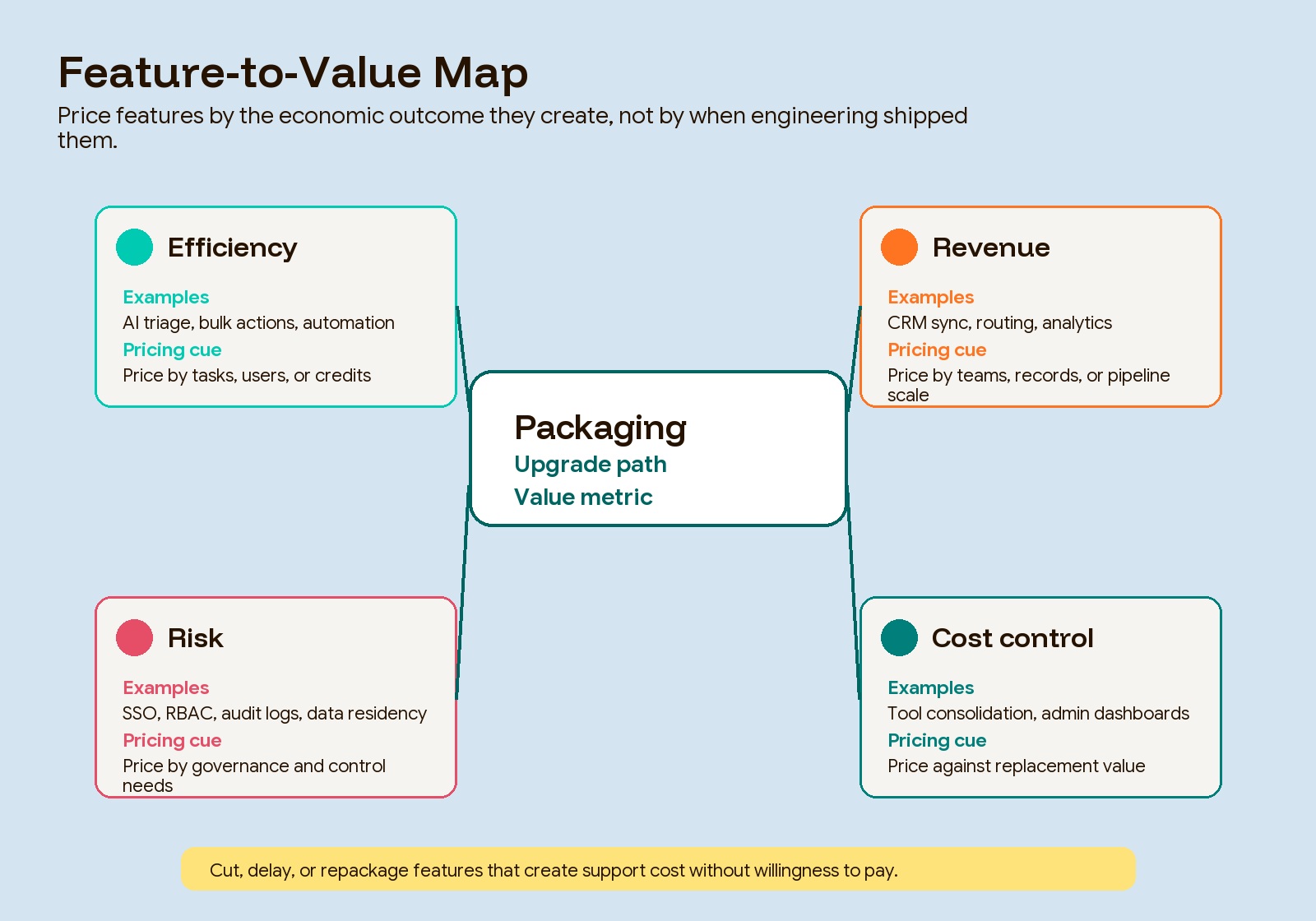
Use four value buckets:
| Feature Type | Buyer Value | Examples | Pricing Implication |
|---|---|---|---|
| Efficiency | Saves labor or reduces cycle time | AI triage, bulk actions, workflow automation | Price by usage, tasks, credits, seats, or process volume |
| Revenue | Improves pipeline, conversion, or retention | CRM sync, routing, analytics, personalization | Tie tiering to teams, records, conversion workflows, or revenue scale |
| Risk | Reduces compliance, audit, data, or permission risk | SSO, RBAC, audit logs, data residency | Keep required baseline protection in every plan; price additional administration or deployment scope separately |
| Cost control | Replaces tools or reduces internal ops | Consolidated dashboards, shared workspaces, billing controls | Package against replacement value and admin scope |
Every plan must retain the protection necessary for its users and data: authentication, authorization, tenant isolation, safe data handling, and operational security logging where required. Do not make a customer pay extra to prevent another account reading their records. Advanced identity federation, customer-facing audit retention, or a dedicated deployment can be scoped separately only when the base plan remains appropriate and safe.
This exercise also protects product scope. If a feature has no clear value bucket, it may still be useful, but it should not automatically drive pricing. If it creates value only for a narrow segment, it may belong in an add-on, enterprise tier, or service-assisted pilot. If it creates high support cost but low willingness to pay, it may need to be cut, automated, or delayed.
Use Research, But Do Not Trust Polite Answers
Pricing research should combine qualitative discovery with quantitative validation. Customer interviews are useful for language, objections, buying process, and perceived alternatives. They are weak for exact willingness to pay because buyers often understate what they would pay, especially if they think the answer may affect future negotiation.
Use interviews to learn:
- What budget the buyer already controls.
- What tool, spreadsheet, manual process, or agency the product replaces.
- Which outcome would make renewal obvious.
- Which feature sounds valuable but does not change buying urgency.
- Which internal stakeholder would block the purchase.
Then use structured methods to test the package. Gabor-Granger questions can test purchase intent at different price points. Conjoint analysis can test tradeoffs between features, limits, service levels, and prices. Conjointly’s guide to software pricing simulation is useful because it treats pricing as a set of realistic package choices rather than a single “what would you pay?” question.
For early-stage SaaS, do not overbuild the research program. Ten focused pricing calls with the right buyers can reveal more than a large survey of the wrong audience. The key is to separate the variables:
- Show the package first. Ask whether the grouping makes sense.
- Show the billing metric next. Ask whether the unit feels fair.
- Show the price last. Ask where the buyer would hesitate, approve, or route the decision.
If the buyer understands the package but rejects the metric, changing the feature list will not fix the problem. If the buyer accepts the metric but cannot explain the upgrade path, the tier fences are weak. If the buyer accepts both but stalls at price, the value proof or ROI story may be underdeveloped.
Run Fake-Door Tests With a Price Signal
Fake-door testing is useful when a team needs behavioral evidence before building. Amplitude defines a fake-door test as presenting an entry point for a feature or offer that is not fully available yet, then measuring user interest before investing in the build.
For pricing validation, the fake door should include a price signal. A button that says “Try advanced reporting” measures curiosity. A button that says “Upgrade to Growth for advanced reporting” measures a stronger form of intent. The click should lead to a transparent message: the feature is being evaluated, the user can join the pilot list, and the team may follow up for a short call.
Good fake-door tests include:
| Test | Example | Strong Signal | Weak Signal |
|---|---|---|---|
| Pricing page test | Add a new Growth tier for new visitors | Clicks plus demo requests from target accounts | Clicks from unqualified traffic |
| In-product upgrade prompt | Show premium export inside a reporting workflow | Existing users click and join a pilot | Users click once but ignore follow-up |
| Product-led signup gate | Offer self-serve paid signup after trial activation | Activated users enter payment or request approval | Many signups, low activation, high support |
| Add-on test | Offer AI credits, compliance pack, or integration pack | Buyers accept a separate line item | Buyers expect it inside the base plan |
Do not use fake doors as a trick. The trust-preserving version is explicit after the click, limits exposure, and gives users a useful next step. It also defines success before the test starts. For example: “If 12% of activated admin users click the premium export prompt and 30% of clickers join the pilot, we will run five discovery calls before scoping the build.”
Choose Seat, Usage, Credit, or Hybrid Pricing by Value Metric
The right SaaS pricing model depends on the unit of value. Seat-based pricing works when value grows with people using the system. Usage-based pricing works when value grows with consumption. Hybrid pricing works when the customer needs budget predictability and the vendor needs protection from variable cost.
| Model | Works Best When | Breaks When |
|---|---|---|
| Per seat | Collaboration, permissions, and human access drive value | Teams share seats, adoption is penalized, or AI does work without users |
| Usage-based | API calls, records, transactions, data, or compute track value | Customers fear bill shock or reduce usage to control cost |
| Credit-based | AI actions or variable-cost workflows need a simple unit | Credits feel abstract or do not match business outcomes |
| Hybrid | Enterprise buyers need a base commitment plus scalable overages | Billing is too complex for customers or internal teams |
| Outcome-based | A measurable result can be cleanly attributed | Disputes arise over what counts as a successful outcome |
AI SaaS makes this decision sharper. A flat seat price can work for normal human usage, but AI workflows may create variable inference, retrieval, storage, and monitoring costs. Google publishes Gemini API pricing by token and capability, and Anthropic publishes Claude pricing by input, output, caching, and other usage dimensions. Those provider costs can change, but the product lesson is stable: AI features need a pricing model that protects gross margin when usage scales.
For vertical SaaS, the value metric may not be seats at all. It may be restaurants, locations, assets, inspections, transactions, providers, patients, properties, or vehicles. Toast is a useful example of vertical expansion because it started with restaurant point-of-sale and expanded into adjacent restaurant operations such as payroll, inventory, online ordering, and broader platform services, as described in Tidemark’s profile of Toast’s vertical SaaS strategy. The pricing lesson is not “copy Toast.” It is that vertical SaaS packaging often grows by owning more of the customer’s operating system.
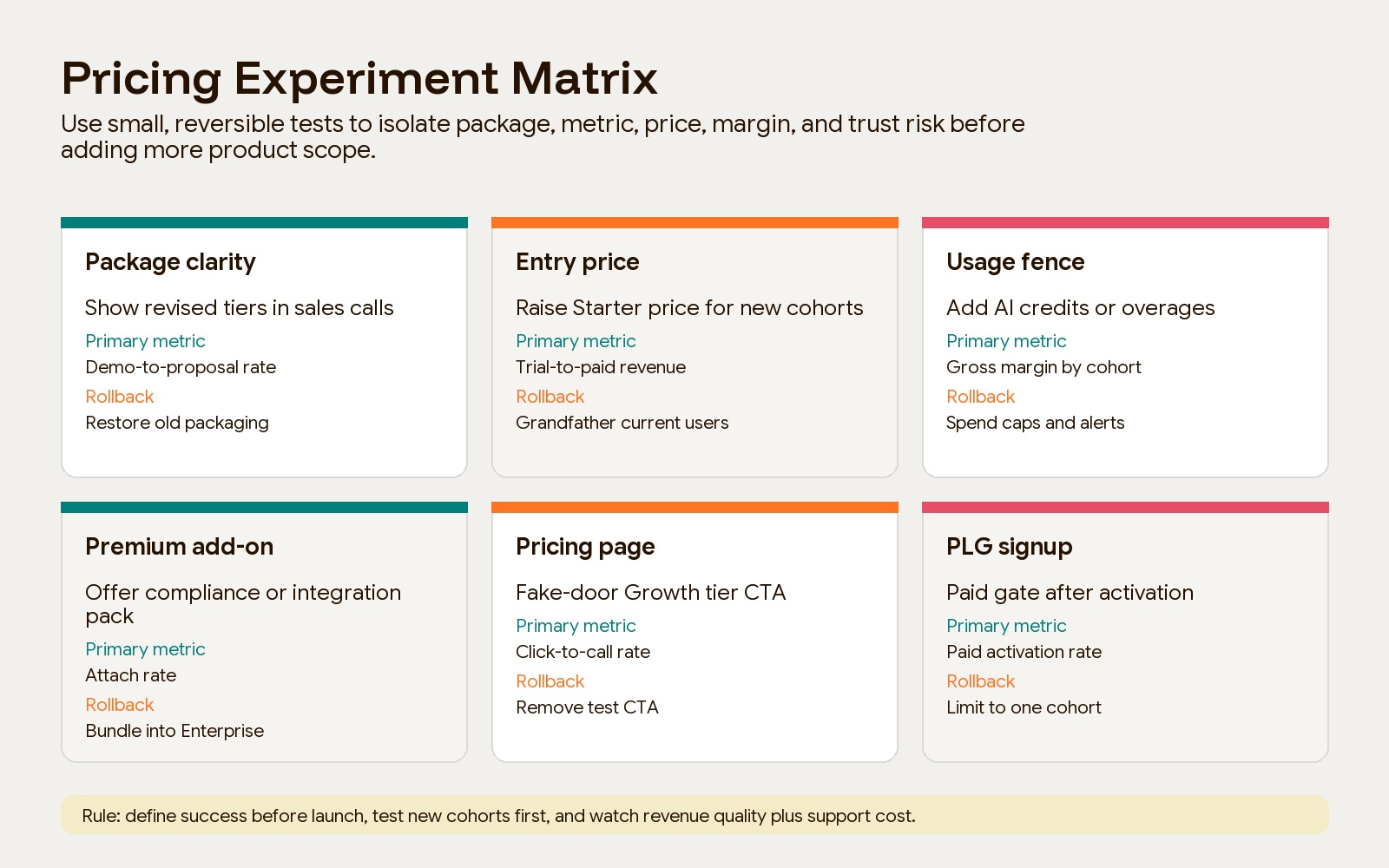
Pricing Experiment Matrix
Use a matrix so pricing experiments stay small, reversible, and measurable. Each test should have a hypothesis, audience, primary metric, guardrail, and rollback plan.
| Experiment | Hypothesis | Best Audience | Primary Metric | Guardrail | Rollback Plan |
|---|---|---|---|---|---|
| New tier naming | Buyers understand outcome-based tiers faster than feature-heavy tiers | New prospects | Demo-to-proposal rate | Sales cycle length | Restore old page copy |
| Starter price lift | Entry customers will pay more if support scope is clearer | New self-serve signups | Trial-to-paid revenue | Activation and refunds | New cohorts only |
| Free-to-paid gate | A low-cost plan filters support-heavy free users | Product-led signups | Net new paid accounts | Support tickets per account | Grandfather existing free users |
| Seat-to-hybrid | Usage credits capture AI-heavy accounts without hurting base predictability | Existing high-usage accounts | Gross margin and expansion MRR | Contraction and complaints | Pilot with spend caps |
| Premium add-on | Compliance, integrations, or AI automation can sell separately | Qualified mid-market accounts | Add-on attach rate | Renewal risk | Bundle into enterprise tier |
| Pricing-page fake door | Visitors will request a higher package before the feature is built | New visitors by segment | Click-to-call or waitlist rate | Bounce rate | Remove CTA after test window |
Before running a test, specify eligible accounts, unit of analysis, exposure window, expected baseline, minimum decision-relevant effect, and stopping rules. For example, a low-volume B2B team could observe one defined prospect cohort through its full trial and procurement window, then interview every buyer who reached a decision. That is directional research, not statistical proof. For a randomized experiment, size the sample from the baseline and effect you need to detect; report uncertainty and an inconclusive outcome when volume is insufficient. Do not repeatedly stop at the first favorable result. The sample 12%/30% click rules above are illustrative screening signals, not demonstrated willingness to pay.
Testing new cohorts first can reduce disruption. Existing customers may deserve grandfathering, transition windows, or clear upgrade credits. That is not just kindness. It prevents a pricing test from turning into a trust problem.
Pricing Risk Checklist
Every pricing change has risk. The work is to make the risk visible before launch.
| Risk | Diagnostic Question | Control |
|---|---|---|
| Customer backlash | Who will feel punished by the change? | Grandfathering, migration credits, clear notice |
| Margin erosion | Which accounts can create high cost without paying more? | Usage caps, credits, overages, account-level margin tracking |
| Support drag | Which tier creates the most tickets per dollar of revenue? | Support limits, onboarding automation, better plan fences |
| Sales confusion | Can reps explain the model in two minutes? | Pricing FAQ, objection handling, packaging slide |
| Billing complexity | Can finance invoice and recognize revenue cleanly? | Standard contract rules, billing-system readiness |
| Product debt | Are limits hardcoded into the application? | Decoupled entitlement and billing logic |
| Upgrade blockage | Do customers know when they should move up? | Visible thresholds, admin prompts, usage dashboards |
| Competitive reaction | Are customers buying on price alone? | ROI proof, segment focus, outcome-based positioning |
This checklist is where pricing connects back to engineering. If the team cannot change plan limits without code changes, the pricing model is not ready for experimentation. If the billing system cannot support credits, overages, add-ons, or grandfathered plans, a hybrid pricing strategy may create operational debt faster than revenue.
Metrics to Watch After a Pricing Test
A pricing test should be judged by a small set of monetization and product-health metrics, not only conversion rate.
| Metric | Why It Matters |
|---|---|
| Trial-to-paid rate | Shows whether the entry package and price fit the activation journey |
| Average revenue per account | Shows whether the model captures more value per customer |
| Expansion MRR | Shows whether the upgrade path is working |
| Net revenue retention | Shows whether expansion offsets churn and contraction |
| Gross margin by cohort | Shows whether usage-heavy accounts are profitable |
| Support tickets per paying account | Shows whether the package creates hidden operating cost |
| Sales cycle length | Shows whether buyers understand the model |
| Discount rate | Shows whether the price is trusted or constantly negotiated down |
| Churn and contraction | Shows whether the change damages retention |
Benchmarks can help, but definitions matter. A CAC payback number that excludes salaries is not the same as one that includes fully loaded sales and marketing cost. An NRR number that hides downgrades will overstate pricing health. For this article, the useful operating principle is simple: a good pricing model should improve revenue quality without creating support, margin, or trust debt.
What Real Pricing Validation Looks Like
Two patterns from public pricing work are worth noting.
The first is packaging simplification. Willingness to Pay describes a SafeEx Cloud pricing redesign where the model moved from a broad, one-size-fits-all approach into clearer tiers and add-ons for a hazardous-area maintenance and inspection platform. The important lesson is not the exact tier names. It is that vertical SaaS packaging often improves when the company separates core workflow value, advanced controls, and service-provider economics.
The second is migration discipline. Valueships reports that LiveSession achieved a 30% MRR increase after research, scenario planning, and moving customers from an underpriced legacy plan into higher-value tiers. The lesson is that pricing changes should be modeled and migrated, not sprung on customers because the company finally realized the plan was cheap.
Both examples point to the same rule: validate the model before using the pricing page as the announcement.
The Founder Takeaway
SaaS pricing validation should happen before more features because pricing reveals what the market actually understands. If customers cannot see the value, the next feature may not fix the problem. If the wrong unit is priced, growth may create margin pressure. If the package has no upgrade trigger, the roadmap may produce usage without expansion.
Treat pricing as a product system:
- Map features to customer value.
- Define the package and upgrade path.
- Test willingness to pay with real buyers.
- Run fake-door or sales-call experiments before building.
- Choose the billing metric that matches value and cost.
- Monitor revenue, retention, support, and margin together.
The best SaaS pricing strategy is not the cleverest table. It is the one that helps the right customer buy, helps the product team prioritize, protects support and gross margin, and gives accounts a natural reason to grow.