Founders often ask this as a budget question: should we buy fractional CTO services or hire a senior engineer?
That is the wrong starting point.
The useful question is: do you already know what needs to be built, or do you need senior judgment to decide what should be built, how risky it is, and who should own it?
If the answer is clear and the work is execution-heavy, a senior engineer may be enough. If the answer is still fuzzy, the product has meaningful architecture risk, the team needs technical direction, or investors are asking hard questions, a fractional CTO is usually the better first move.
The difference is not status. It is responsibility. A senior engineer adds execution capacity. A fractional CTO adds technical leadership, decision quality, and risk ownership.
Fractional CTO services vs senior engineer: the real difference
A senior engineer is usually hired to build, improve, and maintain software. They may make technical decisions inside the codebase, mentor other developers, and own delivery quality. A great senior engineer can absolutely change the trajectory of a startup.
A fractional CTO works at a different altitude. They decide whether the technical path supports the business path. That includes architecture, roadmap tradeoffs, hiring sequence, vendor review, security posture, technical debt, delivery risk, and the story a founder needs to tell investors or enterprise buyers.
Rob Bowley makes a useful version of this distinction in his essay on CTO or founding engineer: a founding engineer can be the right person when the job is to build the first version quickly, while CTO work becomes necessary when the company needs someone to own the technical direction, team, and risk profile.
That distinction matters because startups often confuse seniority with leadership. The strongest coder is not automatically the right person to make roadmap, budget, hiring, and investor-facing decisions. Sometimes they can grow into that role. Sometimes asking them to do it too early slows everyone down.
Myth 1: A senior engineer can just cover CTO work
Sometimes they can. More often, they can cover pieces of it.
A senior engineer can review code, make architecture recommendations, improve performance, choose tooling, and mentor less experienced developers. Those are valuable responsibilities. But CTO-level work usually adds a business layer:
- What should the product not support yet?
- Which architecture risks are acceptable for this stage?
- Should the startup build, buy, integrate, or defer?
- Is the vendor making reasonable technical choices?
- What kind of engineer should be hired next?
- What technical risks will investors, customers, or auditors question?
- What tradeoffs preserve runway without creating a rebuild later?
Those questions require technical depth, but they are not only engineering questions. They are product, capital, team, and risk questions.
That is where CTO responsibilities differ from senior engineering execution. The CTO role connects technology decisions to company consequences.
Myth 2: Fractional CTO services are just expensive advice
They can be, if the role is vague.
Bad fractional CTO work looks like a weekly call, a few abstract opinions, and no ownership. Good fractional CTO work produces decisions founders can act on: a sharper roadmap, a simpler MVP, a cleaner architecture plan, a better hiring sequence, a vendor decision, or a credible investor diligence narrative.
The point is not to add a title to the org chart. The point is to reduce the cost of wrong technical decisions.
For example, a non-technical founder working with an agency may not know whether the agency is overbuilding, underestimating, choosing the wrong stack, or creating dependency risk. A senior engineer can inspect parts of the implementation. A fractional CTO should also judge whether the whole technical approach fits the business stage.
That difference becomes especially important when the product is approaching a funding round, enterprise sales motion, compliance requirement, or team expansion.
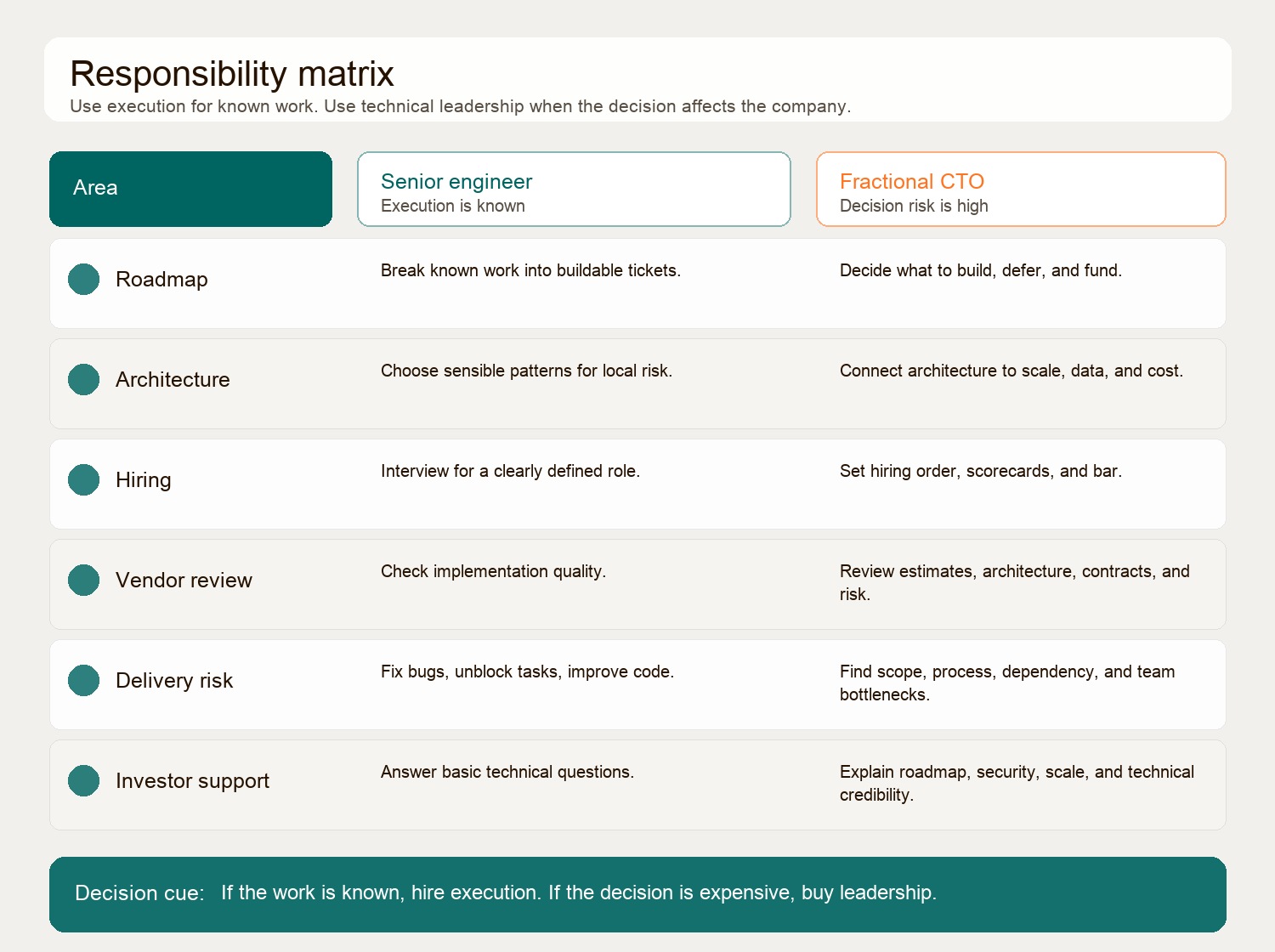
Responsibility matrix: who should own what?
Use this matrix to separate execution work from leadership work. The right answer can be mixed, but one person should still own the decision.
| Responsibility | Senior engineer is usually enough when… | Fractional CTO services help when… |
|---|---|---|
| Roadmap | The product priorities are already clear and the engineer is breaking known work into buildable tickets. | The founder needs help deciding what to build, what to defer, and how technical work maps to business milestones. |
| Architecture | The system is simple, the risk is local, and the engineer can choose sensible patterns without major company impact. | Architecture choices affect scaling, security, integrations, data model, cost, compliance, or future hiring. |
| Hiring | The company needs technical interviews for a well-defined role. | The company needs to define the first engineering roles, hiring order, scorecards, seniority level, and interview process. |
| Vendor review | The vendor is executing a narrow, low-risk scope. | The founder needs an independent review of estimates, architecture, code quality, delivery process, or contract risk. |
| Delivery risk | Delivery is blocked by engineering tasks, bugs, or implementation complexity. | Delivery is blocked by unclear priorities, poor handoffs, weak process, hidden dependencies, or unrealistic commitments. |
| Investor support | Technical questions are basic and the founder can answer them confidently. | Investors, buyers, or partners need credible answers about architecture, roadmap, security, scale, data, or team plan. |
The pattern is simple: if the work is known and the risk is mostly inside implementation, hire engineering execution. If the work is uncertain and the risk affects the company, bring in technical leadership.
When a senior engineer is enough
A senior engineer can be the right hire when the startup needs momentum more than governance.
That is common in these situations:
- The founder or product lead already understands the customer problem clearly.
- The MVP scope is narrow and does not require complex architecture.
- The product is mostly a standard web or mobile application.
- The startup needs reliable implementation, not a new technical strategy.
- There is already a technical co-founder, CTO, or trusted advisor in place.
- The biggest bottleneck is shipping, debugging, or improving existing software.
- The company is still validating demand and should not overdesign the system.
In those cases, hiring a fractional CTO before hiring an engineer can be wasteful. A founder may need someone to build the first useful version, not someone to hold strategic meetings about a product that has not met the market yet.
This is especially true when speed matters more than permanence. If you are testing a landing-page workflow, a lightweight SaaS MVP, an internal tool, or a narrow operational product, a strong senior engineer may be the cleanest answer.
Pave’s guide to first engineering hire compensation is a useful reminder, though: the first senior technical hire is still a major commitment. It is not “cheap execution.” It is a cash, equity, and management decision. Founders should be clear on whether they are hiring a builder, a lead, or a future technical executive.
When fractional CTO services make more sense
Fractional CTO services make more sense when the startup needs better technical decisions before it needs more technical output.
That usually happens when:
- The founder is non-technical and cannot confidently evaluate engineering tradeoffs.
- The product roadmap is expanding faster than the architecture can support.
- The company is paying an agency or offshore team and needs independent oversight.
- The team is choosing between build, buy, automation, integration, or custom software.
- The product will touch sensitive data, payments, healthcare, finance, AI workflows, or compliance.
- The startup is preparing for fundraising, enterprise sales, diligence, or acquisition conversations.
- Delivery feels slow, but no one knows whether the problem is scope, process, architecture, team quality, or product indecision.
- The company is about to hire its first engineer, technical lead, VP engineering, or full-time CTO.
In these cases, another engineer may increase output without fixing the underlying problem. More hands can even make the problem worse if the roadmap is unclear or the architecture is drifting.
A fractional CTO should create clarity before scale. They should help the founder decide the next technical move, then make sure the team can execute it.
Myth 3: If the engineer is senior enough, they should own everything
This is how many startups accidentally promote someone into a role they did not choose.
A senior engineer may enjoy deep technical execution. They may not want to manage vendors, explain tradeoffs to investors, define hiring scorecards, handle roadmap politics, or own executive-level risk. That does not make them less senior. It means their best leverage is different.
The reverse is also true. Some senior engineers are clearly growing into CTO work. They show product judgment, communicate clearly with non-technical people, make calm tradeoffs under uncertainty, understand hiring, and think in systems instead of tickets. Those people can become excellent startup CTOs.
The mistake is assuming the transition happens automatically.
If a founder wants a senior engineer to become a technical leader, define that path explicitly:
- What decisions do they own?
- What business context do they need?
- Which meetings should they join?
- How will hiring and vendor review be handled?
- What support or coaching do they need?
- When should the company bring in outside technical leadership?
This is where a fractional CTO can be useful even when a strong engineer is already on the team. The fractional CTO can coach the engineer, review major decisions, and help the founder avoid forcing one person to learn executive judgment alone.
What a fractional CTO should not do
Fractional CTO services are not the right answer for every technical gap.
Do not hire a fractional CTO when you only need:
- A developer to ship a fixed backlog.
- A code reviewer for a one-time implementation issue.
- A project manager with no technical decision authority.
- A symbolic CTO title for investor optics.
- Someone to bless decisions after they have already been made.
Also be careful in deep-tech companies where the core technology is the company. If you are building a database engine, cryptography system, compiler, complex AI model, or regulated clinical device, a few hours a week may not be enough. You may need a full-time technical co-founder, CTO, or chief scientist living inside the work.
The same applies once the engineering team is large enough that daily leadership becomes the job. At that point, a fractional CTO may still advise, but they should not be the only technical leader.
The hybrid path: senior engineer plus fractional CTO
For many startups, the answer is not either-or.
The best structure is often a senior engineer or small engineering team paired with a fractional CTO for defined leadership moments.
That can look like:
- Monthly roadmap and architecture review.
- Vendor estimate and delivery review before a major build.
- Hiring scorecards and interview loops for the first technical hires.
- Investor diligence prep before a fundraise.
- Technical debt triage before scaling a product.
- Coaching a senior engineer who may become the technical lead.
The Hatchpad interview about Till’s transition from fractional CTO to full-time CTO shows the useful version of this handoff. The fractional leader helped establish the early technical footing, then stepped back as the company brought in permanent leadership. The important part was not protecting a title. It was transferring context cleanly.
That is what good fractional leadership should do: help the startup make better decisions now and become less dependent on the fractional leader over time.
How founders should choose
Use the smallest role that can own the real problem.
If the problem is “we know what to build and need someone excellent to build it,” hire a senior engineer.
If the problem is “we are not sure what to build, how to build it, who to hire, or whether our current technical path is safe,” use fractional CTO services.
If the problem is “technology is now central to our company and we need daily leadership,” start planning for a full-time CTO or technical co-founder.
The most expensive mistake is not choosing the wrong title. It is hiring for execution when the company needs judgment, or hiring for strategy when the company simply needs someone to ship.
For startups, the practical answer usually comes down to one question: which technical decision is now expensive enough that the founder should not make it alone?
If that decision is roadmap, architecture, hiring, vendor review, delivery risk, or investor support, fractional CTO services can be the right bridge. If the decision is already made and the work is clearly scoped, a senior engineer may be exactly enough.
The Hapy view
Hapy does not treat technical leadership as a title exercise. We care about the business consequence of the technical decision.
Sometimes that means helping a founder shape the first version through MVP Development. Sometimes it means reviewing architecture, vendor quality, delivery risk, or hiring plans through a technical leadership lens. Sometimes the honest answer is that the startup does not need a CTO yet. It needs a strong engineer and a narrower product scope.
The founder-facing goal is simple: spend senior judgment where the decision is expensive, and spend engineering execution where the work is clear.
That is how startups keep technical work tied to learning, selling, raising, and scaling instead of turning technology into another expensive source of uncertainty.