A fractional CTO hourly rate is not just the price of a senior person joining calls. It is the price of reducing technical risk before a startup commits money, hires, code, vendors, architecture, or investor promises in the wrong direction.
For founders comparing CTO options, the useful question is not “Who is cheapest per hour?” The better question is: “Which decisions are expensive enough that we need senior technical judgment now?”
That framing changes the whole buying process. Advisory pricing, monthly retainers, embedded CTO support, and project-based engagements are not interchangeable packages. Each model buys a different level of responsibility. The right model depends on company stage, technical uncertainty, team maturity, and how much follow-through the CTO is expected to own.
If you need the role definition first, start with Hapy’s guide to a fractional CTO. If you are comparing service scopes, read the guide to fractional CTO services. This article focuses on the pricing question founders actually face: what are you paying for when fractional CTO proposals differ substantially?
What is a realistic fractional CTO hourly rate?
There is no single market rate that answers the buying question. Commercial guides advertise different hourly, daily, retainer, and project ranges, but their geography, sample, inclusions, and methods are not consistently comparable. Treat them as directional seller material, not an independent compensation survey.
Request current quotes for a named market, currency, availability, deliverables, and decision mandate. Separate advice from implementation and incident coverage. Do not assume a regulated-sector or AI premium without a scoped explanation.
| Pricing model | Typical use | What the founder is buying | Where it breaks |
|---|---|---|---|
| Advisory hourly | Narrow questions, architecture review, hiring interviews, vendor review | Senior judgment without a long commitment | Advice may not turn into execution |
| Retained CTO | Ongoing technical leadership, weekly decision rhythm | Context, continuity, roadmap and architecture judgment | Scope can sprawl if decision rights are vague |
| Embedded CTO | Active product and engineering leadership | Operating involvement across team, vendors, delivery, hiring, and stakeholders | Too expensive if the startup only has occasional questions |
| Project-based CTO | Technical audit, due diligence, roadmap reset, migration plan | A defined deliverable with budget clarity | Can miss new risks if discovery is too shallow |
The rate should follow responsibility. When the role moves from “answer my question” to “help own the technical outcome,” the pricing model should move too.
Pricing should follow risk, not title
The word “CTO” hides too much. In one startup, a fractional CTO may spend five hours checking whether an MVP vendor has over-scoped the build. In another, the CTO may need to inspect a brittle codebase, change the cloud architecture, interview senior engineers, calm investor diligence concerns, and stop a roadmap from outrunning the team.
Those jobs carry different risk.
The cost drivers that matter most are:
- Irreversibility: How hard will it be to unwind the decision later?
- Blast radius: Could the wrong call affect users, revenue, compliance, data, or fundraising?
- Founder dependency: Can the founder execute advice alone, or does the company need a technical operator in the room every week?
- Team maturity: Is there a strong engineering lead already, or is the CTO filling a leadership vacuum?
- Vendor exposure: Is an outside team making architecture and delivery decisions on the founder’s behalf?
- Diligence pressure: Will investors, acquirers, enterprise buyers, or security reviewers inspect the technical story?
This is why a cheap advisory model can be right at idea stage and dangerously underpowered at seed or Series A. It is also why a deep embedded retainer can be wasteful before the company has enough real technical decisions to justify it.
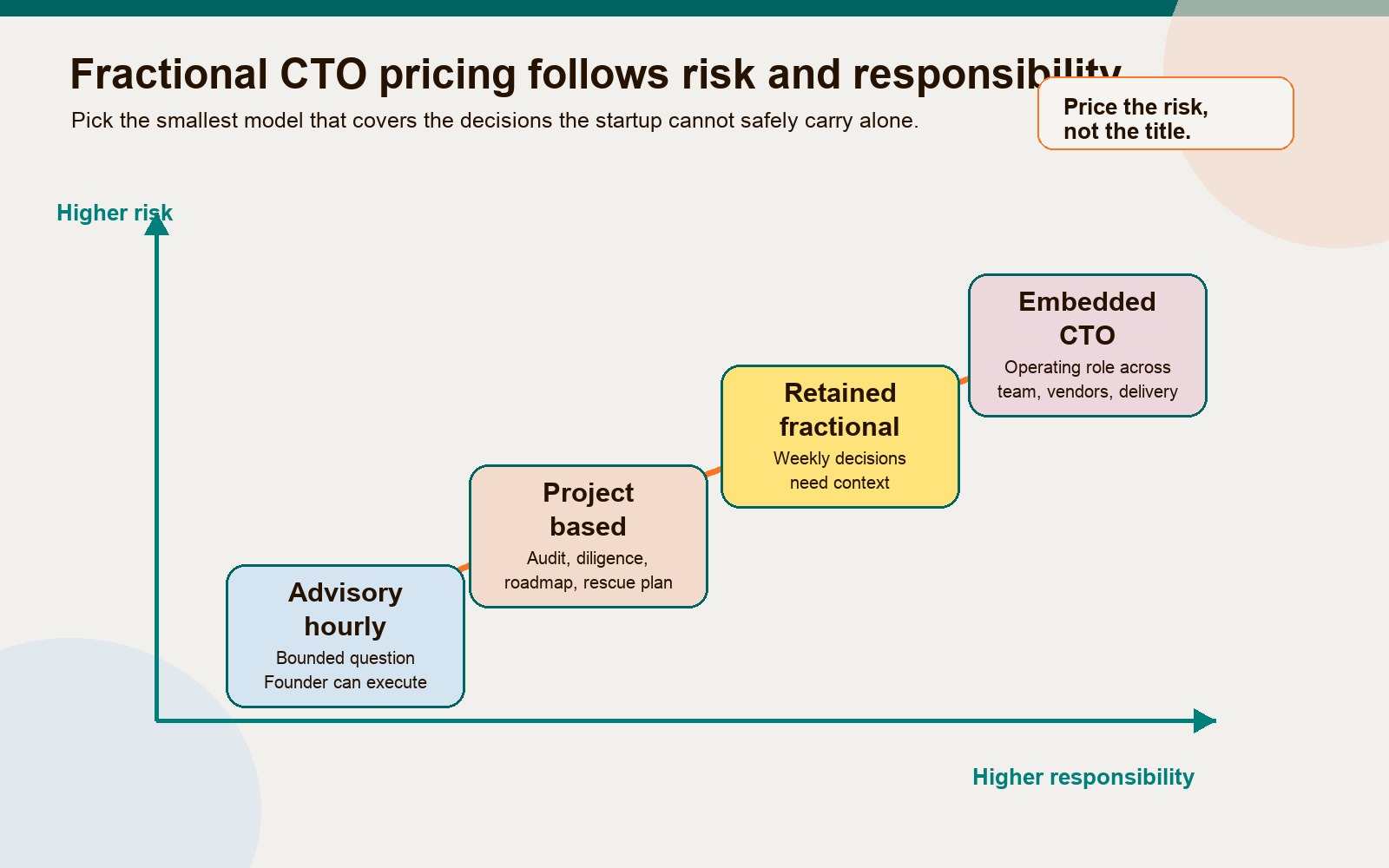
Startup stage vs the right CTO engagement model
The right CTO model changes as the startup moves from idea to traction to scale. A founder should not buy senior technical leadership as a status symbol. They should buy the smallest model that responsibly covers the next set of decisions.
| Startup stage | Main technical risk | Best-fit CTO model | Why it fits |
|---|---|---|---|
| Idea or pre-build | Building before validating the problem | Advisory sprint or technical partner | The founder needs scoping judgment, not a permanent executive layer |
| Pre-seed MVP | Wrong architecture, wrong vendor, weak build plan | Advisory plus project-based MVP planning | Decisions are important, but the rhythm may still be episodic |
| Seed with product live | Technical debt, hiring gaps, delivery slowdown | Monthly retained fractional CTO | Recurring decisions need context and follow-through |
| Preparing to raise | Investor diligence, roadmap credibility, security questions | Project-based diligence prep or retained CTO | The company needs a defensible technical story and risk register |
| Series A or scaling | Team structure, platform reliability, multi-product complexity | Embedded fractional or interim CTO | The role now touches hiring, delivery, architecture, and leadership cadence |
| Permanent executive need | Technology leadership is daily and strategic | Full-time CTO | Fractional support is no longer enough if the company uses CTO capacity five days a week |
This table is deliberately stage-led, not rate-led. If a startup has no users, no team, and no validated workflow, a large retainer may create expensive meetings. If the product is live, customers are complaining, and engineers are blocked by architecture debt, a few advisory calls may be theater.
What founders are really paying for
A fractional CTO engagement should make important technical risks and options clearer. Its effect must be assessed from the decisions and follow-through in your engagement; an avoided quarter or rewrite cannot be assumed.
That matters because startup software decisions compound. A weak architecture choice can slow every later feature. A poor first engineering hire can set the wrong quality bar. A loose vendor agreement can create code, data, or documentation dependency. A missing security plan can stall enterprise sales or investor diligence.
The broader data supports the business case for treating software risk seriously. The Bureau of Labor Statistics tracks new business establishment survival by birth cohort and notes that survival rates vary by industry. In software specifically, research on early-stage startup failure found a recurring gap between the strategy founders say they need, such as problem-solution fit, and the execution pattern they often follow, which is rushing to launch before the learning process is complete.
The same pattern shows up inside technical work. CISQ’s 2022 report estimated the US cost of poor software quality at $2.41 trillion and accumulated software technical debt at about $1.52 trillion. A startup will not experience those numbers at enterprise scale, but it can experience the same mechanics in miniature: defects, rework, fragile releases, security gaps, support drag, and delayed roadmap work.
That is the hidden value of a strong CTO engagement. The invoice is visible. The avoided rewrite is not.
What makes a cheap CTO expensive
A cheap CTO is not expensive because their hourly rate is low. A cheap CTO is expensive when the engagement fails to cover the risk the startup actually has.
The common failure modes are predictable.
Poor architecture
Architecture debt is expensive because it turns future work into rework. The warning sign is not that the stack is unfashionable. The warning sign is that nobody can explain the boundaries: where the data lives, how permissions work, how services connect, how errors are monitored, how releases happen, and what would break under customer growth.
If the CTO only gives high-level advice without inspecting the product, codebase, infrastructure, or vendor plan, the founder may still be carrying the real architecture risk alone.
Bad hiring
Hiring risk is not just picking the wrong engineer. It is defining the wrong role. Many startups hire for raw coding speed when they actually need product judgment, backend reliability, QA discipline, data modeling, or technical leadership.
A fractional CTO should help define scorecards, interview signals, seniority needs, and the first 90 days of ownership. If they only “take a quick interview” with no role design, the founder is still guessing.
Missed due diligence
Investor and buyer diligence usually reveals weak documentation, unclear architecture decisions, security gaps, cloud cost surprises, brittle deployment practices, and dependency on one developer or vendor. A low-cost advisor who is not accountable for the diligence story may be cheaper up front and costly when the raise, sale, or enterprise deal slows down.
For many startups, a project-based technical due diligence prep sprint is more useful than a broad retainer. The output should be concrete: architecture notes, risk register, remediation backlog, infrastructure summary, security posture, data flow, roadmap assumptions, and answers to likely investor questions.
Weak vendor control
Vendor control is where many non-technical founders quietly lose money. A development vendor may be honest and still optimize for billable scope, familiar tools, or delivery convenience rather than company-level technology strategy.
A CTO should pressure-test estimates, challenge build-versus-buy decisions, review architecture, check code ownership terms, define acceptance criteria, and make sure delivery updates are tied to working software. Without that control layer, the founder may pay less for CTO help and more for vendor drift.
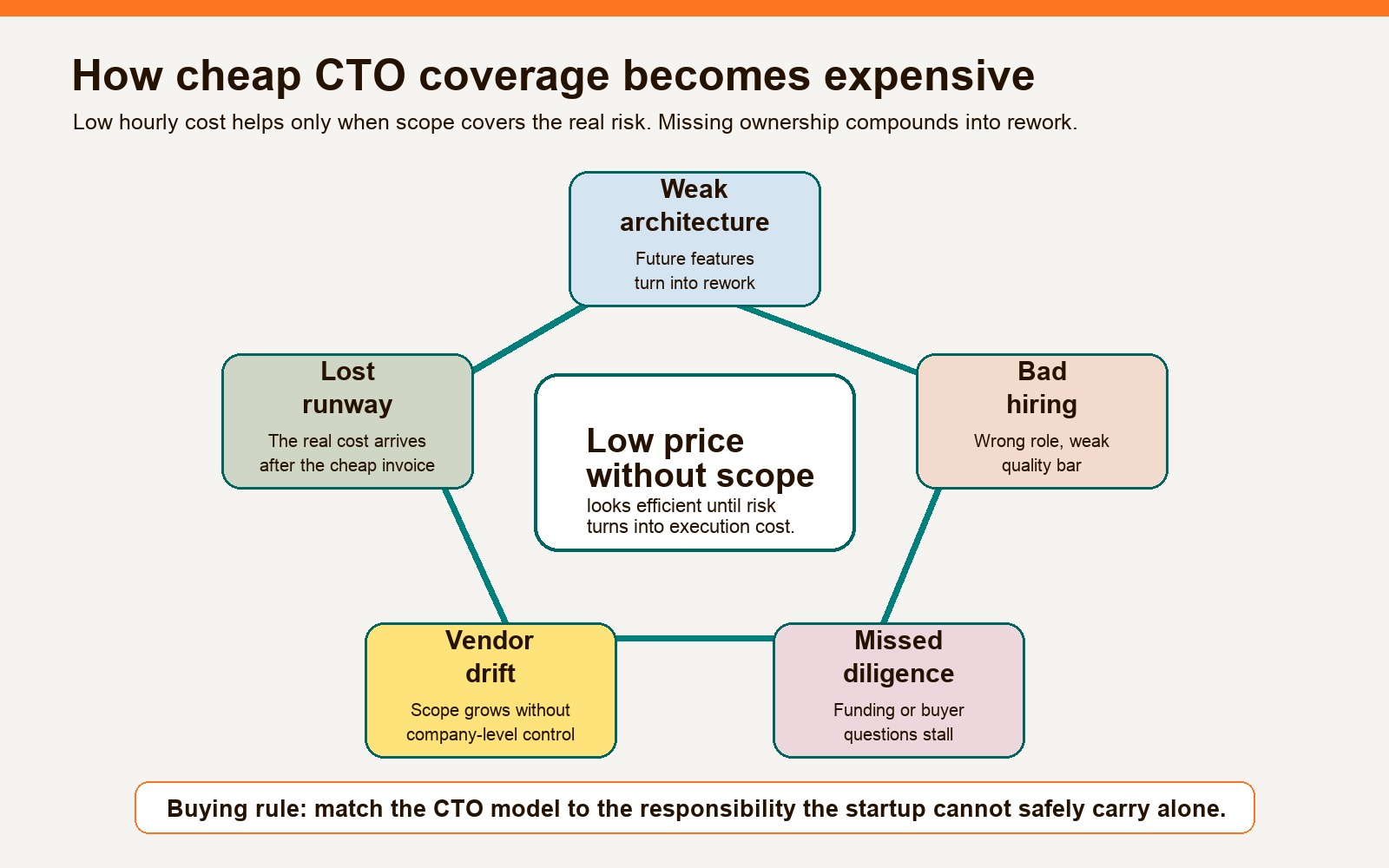
Hourly, retained, embedded, or project-based?
Use the pricing model that matches the decision load.
Use hourly advisory when the question is narrow and the founder or team can execute the answer. Examples include reviewing a vendor proposal, checking an MVP scope, interviewing a senior candidate, preparing for a board question, or getting a second opinion on architecture.
Use a retained fractional CTO when technical decisions happen every week. This is the better model when the CTO needs context across roadmap, engineering, architecture, hiring, vendor review, and delivery tradeoffs. It usually pairs well with a small internal team or a founder-led product team.
Use embedded CTO support when the company needs operating involvement, not just advice. Embedded work fits startups with live product pressure, engineering team growth, enterprise buyers, investor diligence, reliability problems, or a roadmap that requires technical sequencing.
Use project-based pricing when the outcome is concrete. Good project scopes include technical due diligence prep, architecture audit, codebase rescue plan, cloud cost review, security remediation roadmap, platform migration plan, or MVP technical blueprint.
The common mistake is buying the model that feels cheapest rather than the model that fits the responsibility. Hourly work is efficient for bounded questions. Retainers are efficient for recurring context. Embedded support is efficient when the CTO has to help the organization change how technical decisions get made.
Fractional CTO cost vs full-time CTO cost
The full-time comparison matters, but salary averages alone do not answer the decision. A permanent CTO can be the right hire when technology leadership is core to the business every day, the company needs a long-term executive, and the role has enough work to justify full-time capacity.
The hidden cost is that full-time compensation is not only salary. Include the actual employer benefit and payroll costs for the proposed hire; a broad industry average is not an executive compensation quote. For an executive hire, founders also need to consider recruiting time, search fees, equity, onboarding delay, and the cost of a wrong hire.
That does not mean fractional is always cheaper in the way that matters. A $20,000/month fractional CTO who cannot get enough access, decision authority, or operating rhythm may be expensive. A full-time CTO may be the better economic choice once the company needs daily leadership.
Use this decision rule:
| If the company needs… | Prefer… |
|---|---|
| A second opinion on a bounded technical decision | Hourly advisory |
| A risk map, architecture plan, or diligence package | Project-based CTO work |
| Weekly technical leadership without a full executive hire | Retained fractional CTO |
| Active operating leadership across product and engineering | Embedded fractional or interim CTO |
| Permanent ownership of technology strategy and team leadership | Full-time CTO |
If you are comparing total budget ranges, Hapy’s fractional CTO cost guide breaks down hourly, retainer, day-rate, and project pricing. Hapy’s CTO as a service guide is useful when you are comparing fractional, virtual, interim, and outsourced models.
An illustrative scope-to-fee calculation
Suppose a proposal offers 24 hours for architecture review, a risk register, two hiring interviews, and a decision workshop at an assumed $250/hour. That is $6,000 before taxes or other charges. This is arithmetic for comparing scope, not a market benchmark or a Hapy quote.
Ask how those hours are allocated, what access is required, who performs remediation, and what happens if discovery finds a larger problem. Define acceptance as usable deliverables reviewed with the engineering owner. Track whether named decisions are resolved and whether implementation follows; do not count hypothetical avoided losses as realized savings.
The 30-day test before you commit
Before signing a large retainer, ask what the first 30 days will produce.
A serious fractional CTO engagement should create clarity quickly:
- A technical risk register that separates small debt from structural risk.
- A map of current architecture, infrastructure, data flows, and vendor dependencies.
- A decision backlog showing which calls need founder, CTO, product, engineering, or vendor ownership.
- A hiring or vendor control plan if outside people are shaping the product.
- A 90-day technical roadmap tied to business priorities.
This is the practical test of whether the CTO is reducing risk or selling time. Good technical leadership makes the next decision easier to see.
The founder takeaway
The fractional CTO hourly rate is only useful after you know what risk the CTO is supposed to carry. Advisory, retained, embedded, and project-based pricing all make sense in the right context. They fail when the founder buys one model and expects another.
If the startup only needs a bounded answer, pay hourly. If the product is live and technical decisions are now weekly, use a retainer. If the company needs operating leadership across architecture, hiring, vendors, diligence, and delivery, expect embedded pricing. If the work has a defined output, price the project.
The cheapest CTO is the one whose scope matches the risk. Anything else is just a lower invoice before the real cost arrives.
Compare Hapy’s engagement options against the decision authority, availability, and deliverables your startup actually needs.